


The money men are returning to the base metals markets. The speculative surges on China’s mainland commodity exchanges may be grabbing the headlines as the authorities tweak trading and margin rates to try and cool the animal spirits of the retail investment crowd.
However, outside of China, managed money is flooding into the likes of copper, nickel and aluminium.
Some of it is “hot” money, computer trading programmes reacting to rapidly changing chart pictures and riding the resulting momentum.
That has been particularly true of copper, which earlier this month punched upwards out of the $4,320-5,130 range that had defined the London market for a year.
But heavier-weight, longer-term investors are also returning to the industrial metals sector for the first time in years.
It may not feel like it to those in the business of producing and trading physical metals but the funds at least seem to think the cycle has turned. The London Metal Exchange’s (LME) Commitments of Traders Report (COTR) shows funds adding net length across the spectrum of the exchange’s base metals contracts.
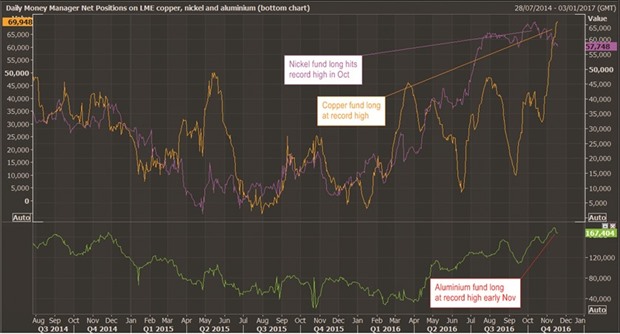
Money managers’ net long positioning on copper hit 70,061 contracts last Thursday, the highest reading since the LME introduced its report in July 2014.
In the London aluminium market, net money manager length hit a record high of 177,445 lots on November 14.
In nickel it happened last month.
Even in those contracts where fresh records haven’t been set, such as zinc, lead and tin, there has still been a significant build-out of long positioning since the start of the year.
True, the LME’s COTR isn’t everyone’s favourite data-set due to problems with how different types of player are classified.
And it has only been running since 2014. But there is plenty of corroborative evidence of the new fund rush.
LME broker Marex Spectron, for example, publishes its own analysis of speculative positioning and it estimates the fund long on copper reached 37% of open interest last week, the largest collective position since April 2006.
And further confirmation comes from the Commodity Futures Trading Commission’s report on copper positioning on the CME’s contract in the United States.
It has just recorded the largest net long by money managers since the report was published in its current format in 2006.
Many of the funds captured by the “money manager” category of both COTRs are trend- and momentum-following and the build of long positioning has coincided with emerging bullish chart patterns over the last couple of months. Remember that before going stratospheric just after the US presidential election, LME copper had already notched up almost two weeks of consecutive higher closes, precisely the sort of technical signal that will attract systematic trading programmes.
But it’s not just the faster, hotter money that is returning to the industrial metals space. It’s been increasingly clear for several months now that commodities are back on the radar of some of the longer-term heavy-weight investment players as well.
Barclays Capital estimates that commodity investment flows were running at all-time highs of $62.3bn in the first nine months of this year.
And while the flows were initially channelled into specific sectors such as precious metals, the evolving trend has been one of increased allocation into broader commodity indices.
In the case of base metals, this has represented the first net inflow of this type of investment money since 2012.
Kevin Norrish, who authors Barclay’s regular “Commodity Investor” reports, suggests that funds are returning for three reasons. Firstly, prices have rebuilt from multi-year lows experienced either late 2015 or early this year.
Commodity indices were up between eight and 13% in the January-September period, the best return on money for many years.
Secondly, commodities have decoupled from other financial instruments, revitalising the idea that they can act as portfolio balancers. Thirdly, the spectre of inflation is once again unsettling fund managers, reviving the sector’s reputation as an inflation hedge.
Such were always supposed to be the reasons for pension funds allocating a small part of their portfolio to commodities. But the rationale for such investment took a battering in the years after 2009-2010, when deflation was more a concern than inflation, commodities moved in close correlation with other risk assets and most experienced significant and prolonged price falls.
n Andy Home is a columnist for Reuters. The views expressed are those of the author.
.