


Iraqi forces have retaken the ancient city of Nimrud, but it has been heavily damaged by the Islamic State group, an AFP journalist who visited the site yesterday said.
Statues lie shattered, a reconstructed palace is wrecked and the remains of a ziggurat - once one of the tallest structures left from the ancient world at some 50m high - has been reduced to a fraction of its height.
Iraqi forces announced that Nimrud, which was founded in the 13th century and became the capital of the Assyrian empire, was recaptured on Sunday as part of the massive operation to retake Mosul, the last IS-held city in the country.
IS overran Nimrud along with swathes of other territory in 2014, but Iraqi forces have since regained much of the territory they lost to the militants.
In April last year, IS released a video of its fighters destroying monuments there before planting explosives around the site and blowing it up.
In the video, militants with sledgehammers and power tools broke artefacts before rigging the site with large barrels of what appeared to be explosives.
IS said it attacked Nimrud as well as other ancient sites, including Syria’s Palmyra and Iraq’s Hatra, to eliminate idols that are forbidden by its extreme interpretation of Islam.
But that has not stopped IS from looting and selling allegedly forbidden artefacts to fund its operations.
Unesco has condemned the destruction of Nimrud as a war crime.
Ali al-Bayati clambered onto the remains of a giant winged bull statue that once stood as a protector of Iraq’s fabled ancient Nimrud before the Islamic State group came.
“When you came here before, you could imagine the life as it used to be,” the local leader and tribal militia commander said.
“Now there is nothing.”
The capital of the kingdom of Assyria some 3,000 years ago, Nimrud was one of the richest archaeological sites in the region.
But after IS took over the area along with swathes of other territory in 2014, it sought to level what remained of the city for propaganda gain.
The militant group released video footage last year of fighters blowing up the remnants of the famed Northwest Palace and smashing stone carvings at the site – destruction it justified as wiping out un-Islamic idols.
Now it appears that almost nothing is left undamaged.
“They want to make a new picture of Iraq – with nothing before Daesh,” Bayati said, using an Arabic acronym for the group.
He said he thought IS “destroyed this place because they wanted to destroy Iraq — the new Iraq and old Iraq”.
Most of Nimrud’s priceless artefacts were moved long ago to museums in Mosul, Baghdad, Paris, London and elsewhere, but giant “lamassu” statues – winged bulls with human heads – and reliefs were still on site.
Now it will take experts to carry out a full evaluation of the damage IS has wrought at Nimrud.
Iraqi forces announced the start of the operation to retake Mosul on October 17, and have closed in on the city from the north, east and south.
The elite Counter-Terrorism Service has recaptured a series of areas inside eastern Mosul, and is still battling the militants in the city.
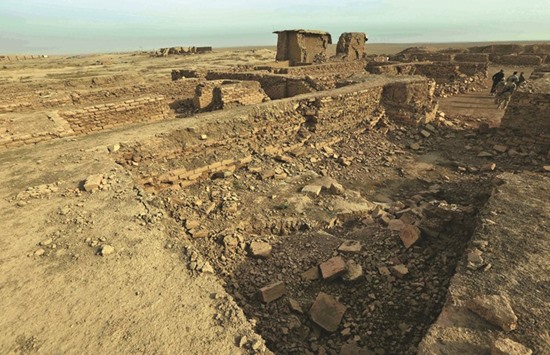
Iraqi soldiers stand amid destruction caused by the Islamic State (IS) group at the archaeological site of Nimrud, some 30km south of Mosul in the Nineveh province, yesterday.