


The quintessential Qatari connection with pearl divers and pearl diving is set to be celebrated through music and drama in an exciting, new project. Brita Fray, an Upper Elementary Music teacher at American School of Doha (ASD) and the director of the Doha Community Orchestra, is staging and directing an original musical The Greatest Treasure, which she has also composed.
The idea blossomed in Fray’s mind around three years ago when she read The Pearl Diver, a children’s book by Julia Johnson. It made her think about the culture of pearl diving in the Middle East, and spurred her on into trying to use the children’s story “as a way to connect to the local culture through music.”
After researching the history of pearl diving in Qatar, and considering the indigenous music of Qatar, Fray worked to bring the two together in a new original work, points out Melissa Scott of ASD, in her piece on Fray’s new foray. “Through music, both instrumental and vocal, and through drama, the musical brings the history of pearl diving to a new audience,” Scott points out.
For the musical, Fray wrote six original songs with accompaniments, which are actually instrumental pieces meant to be played by an Orff ensemble on pitched instruments such xylophones and unpitched percussion. Orff is a specific pedagogical approach which encourages students to learn about music through playing instruments in a sequential way.
When asked what she found most fascinating about the traditional music that pearl divers sang or about Bedouin poetry, Fray told Community, “I found it fascinating that there was a person, a Nahhaam, whose sole job was to sing on the pearling boat. The Nahhaam was so important to the pearling culture that the captain of the boats would seek out the best for their boat. The call and response style of singing was also interesting to me, as it helped keep the crew and divers engaged in their tasks.”
It was important for Fray to bring Bedouin poetic texts into the work, and to also draw from the text of the story to write the lyrics. The pearl divers’ call and response chants-style singing is connected to Bedouin poetry and they incorporated rhythmic hand-clapping in a style called Mawwal, Fray says. “I wanted to draw from those elements as well. The story explores the importance of the family and respecting the sea, so I tried to bring those themes into the musical,” she said.
Fray is also working her way around the more challenging aspect of contextualising those songs and poems to a more diverse audience. She explained, “The most challenging part of composing these songs was to find a way to incorporate the authentic rhythmic and melodic patterns without making it too difficult to perform. Many of the songs were complex and improvisatory in style, including polyrhythmic clapping and percussion. Without understanding the history and origin of the songs, it can be a bit overwhelming to the performer as well as the listener.”
As an expat living in Qatar, Fray sought to connect to the culture of Qatar through her personal language – music, Scott points out. “Initially, she was working on a project for her Master’s degree from VanderCook College of Music, but the work grew into a children’s musical,” Scott mentions. Fray is also collaborating with the Qatar Music Academy Arab Department, where music students from this Academy will form a Tahkt, a small musical ensemble of Arab music, to enhance the instrumental ensemble and bring an Arab sound into the mix. Playing the Oud, Qanun, Tabla, and Nay, these instruments will add authenticity to the piece.
Fray said, “To bring in the Tahkt has added value, in that expat students who are living in Qatar have the chance to see and hear traditional Arab instruments. They are getting a unique experience and it builds their appreciation of music beyond what is familiar to them.”
Interestingly, Qatar Museums’ globe-trotting exhibition entitled Pearls has revealed in detail the exciting and dangerous working methods of pearl divers and given a glimpse into the business practices of the Gulf pearl merchants.
For the Gulf pearls, the golden age was between 1850 and 1920. Qatar and Bahrain were at the heart of this activity, which collapsed in the 1930s owing to several reasons like overfishing, the 1929 economic depression, and the arrival of cultivated pearls from Japan.
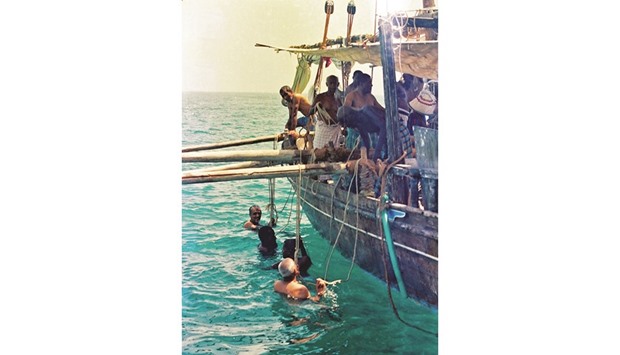
REVISITING THE PAST: For the Gulf pearls, the golden age was between 1850 and 1920. Qatar and Bahrain were at the heart of this activity.