


Siemens announced plans to spin off its $15bn healthcare division in one of the German engineering giant’s biggest portfolio revamps as it narrows focus on energy, transport and factory gear.
The company is seeking to list the asset, with details on the planned scope and timing to follow, Siemens said yesterday as it announced earnings.
“Health care is one of the most attractive businesses, if not the most attractive we have in the company,” chief executive officer Joe Kaeser said in an interview with Bloomberg TV. “We want to focus it more.”
Shares rose in Frankfurt, taking gains to 22% so far this year and making it the third-best performer on Germany’s benchmark DAX Index in the period.
The plan to list its healthcare unit further whittles down the company’s sprawling portfolio, which includes high-speed trains, wind turbines and medical scanners. Over the past decade, Siemens has largely retreated from consumer-oriented products like phones, light bulbs and hearing aids to focus on industrial applications. Among Siemens’s biggest recent divestments was the Osram lighting unit, though chief financial officer Ralf Thomas said it would be “wrong to compare” the asset with health care.
The move reflects a larger trend among conglomerates of portfolio trimming and a stronger focus on core businesses. Royal Philips NV spun off its lighting business in May to focus more on health care, while General Electric Co sold off its appliance unit to China’s Haier Group for $5.4bn in January.
Siemens’s healthcare business competes with GE and Philips as the largest in the world. Following a successful turnaround more than a decade ago, the business has ranked among Siemens’s most consistent performers, and the company has poured billions into acquisitions over the last few years to build up the diagnostics arm.
With a spinoff of health care, Siemens is betting the unit — over which it wants to retain control — can better capture growth and drive investments than would be possible if it remained a stand-alone business, according to Thomas. The division’s weaknesses include ultrasound — and laboratory diagnostic businesses that lag competitors, he said.
“Not everything that glitters is gold,” he said. The division also makes MRI machines and blood-gas analysers.
The announced healthcare spinoff is a “positive surprise” despite the market expecting the move, said Ben Uglow, an analyst at Morgan Stanley in London. The lack of a more concrete timeline makes it hard to judge further and “whether this happens in 2017, 2018, or 2019 is anyone’s guess,” he said.
Kaeser has been shifting the company toward its energy divisions, which include its wind-turbine business, and the CEO said in the interview he doesn’t expect any demand swings in that field from Donald Trump’s ascent to the White House.
Sales in the fourth quarter rose 3% to €21.95bn, while orders slipped 14% after the company took in some large orders in the year-earlier period. The power and gas division led sales growth with a 10% increase, while process industry and drives was the only division to report a decline in sales, driven by increased price pressure. The division was also hurt by €199mn in charges related to job cuts in Germany.
For the 2017 fiscal year, Siemens expects earnings per share of €6.80 to €7.20. Kaeser had previously cautioned about rising geopolitical uncertainty that could dampen 2017 results, and he reiterated today that Siemens continues to anticipate “headwinds” for macroeconomic growth amid a “complex geopolitical environment.” Sales growth will be between 1% and 2% in 2017, while the margin from industrial businesses will reach 10.5% to 11.5%, Siemens said.
The company expects 85% of its under-performing businesses to reach target margins of 6% by the end of the 2017 fiscal year. Currently these businesses have an average margin of 3%.
The company plans to pay a dividend of €3.60 per common share.
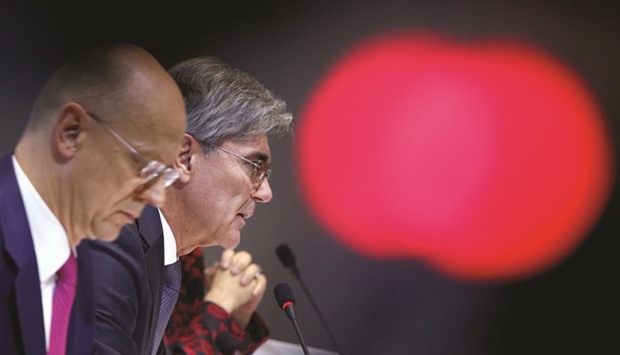
Siemens CEO Joe Kaeser (right) and CFO Ralf Thomas attend the annual news conference in Munich yesterday. u201cHealthcare is one of the most attractive businesses, if not the most attractive we have in the company,u201d Kaeser said in an interview with Bloomberg TV. u201cWe want to focus it more.u201d