


Russia’s worst recession this century may be over. Now what?
The economy’s prospects are so dim that the question of whether it finally exited a technical recession – defined as at least two consecutive quarters of contraction – may be moot. Seasonally adjusted growth in third-quarter gross domestic product was estimated at close to zero by the central bank.
The Economy Ministry says GDP squeaked out a gain of 0.1% from the previous three months, ending a period of decline that the state development lender Vnesheconombank says lasted for eight quarters.
The flatlining may be a sign of what’s to come: crude prices would need to soar more than 40% from now to $70 a barrel for economists to rethink their forecasts for 2017 GDP and inflation, according to 14 of 23 analysts surveyed by Bloomberg. Short of getting a jolt from oil, the options are limited.
Already running the widest budget deficit in half a decade, the government can’t afford to raise budget spending, while the central bank has pledged to hold interest rates the rest of the year to meet its inflation goal in 2017.
“The expectations over economic growth next year are rather modest,” said Ekaterina Vlasova, a former central bank official who’s now an economist in Moscow at Citigroup, which also estimates Russia is technically out of recession. “The process will be relatively lengthy and there’s no reason to expect a repeat of the situation after the crises of 1998 or 2008, when the economy recovered fast.”
The last two recessions set the stage for sharp rebounds as stronger oil prices and a surge in domestic demand and output helped make up lost ground. The economy is in a deeper hole this time after the worst oil crash in a generation as Opec struggles to tackle a global crude surplus.
“The economy is close to exiting the recession, but that isn’t a one-time event and will take some time,” said Oleg Kouzmin, chief economist for Russia at Renaissance Capital in Moscow.
Oil has declined since the Organisation of Petroleum Exporting Countries failed on Friday to agree on country quotas as part of implementing the group’s agreement on cutting output. Russia will stick with verbal interventions to help affect the price of oil instead of actually cutting production in support of a possible deal by Opec, according to most economists surveyed by Bloomberg.
The consensus among executives, traders and officials gathered at the annual Oil & Money conference in London last month was that the world should get used to oil prices between $50 and $60. Citigroup sees prices rising to $65 next year, while trader Gunvor Group envisions an advance to as much as $70, levels last seen in 2014.
“While the recovery to $70 a barrel would equilibrate the federal budget and improve the growth outlook, oil prices above $70 are likely to damage growth through the fast ruble appreciation,” said Natalia Orlova, chief economist at Alfa Bank in Moscow. “The relationship between oil-price growth and GDP recovery is thus not a linear one.”
Russia’s central bank assumes the nation’s main export blend Urals will average $40 in 2017-2019, a level also used to calculate the budget. Under the government’s forecasts that project oil at $55 in 2019, growth may reach 4.4% that year.
Brent crude, which is used to price Urals, traded below $48 a barrel in London on Wednesday. The rouble is the second-best performer in emerging markets after Brazil’s real this year with a gain of almost 16% against the dollar. “Slight” quarterly growth is expected in the last three months of the year, the central bank said in a statement on Friday after keeping its key interest rate unchanged at 10%. It estimates the economy contracted 0.4% to 0.6% from a year earlier last quarter, compared with a drop of 0.6% in the previous three months.
The economy is regaining balance, with relatively low unemployment signaling the output gap isn’t large while the rate of capacity utilisation remains high, according to Bank of Russia First Deputy Governor Ksenia Yudaeva.
“We don’t see signs of a big cyclical contraction,” Yudaeva said in a lecture in Moscow on Wednesday. “On the contrary, we see that the economy is rather close to an equilibrium level and is gradually returning to it.”
GDP actually returned to contraction in September, retreating an annual 0.7% from the previous month and losing 0.2% on a seasonally adjusted basis, the Economy Ministry estimates.
“It’s too early to speak about stagnation being overcome,” Andrei Klepach, chief economist at Vnesheconombank who previously served as the government’s top forecaster at the Economy Ministry, said in a report. “Generally the economy continues to balance on a trajectory close to zero.”
Even so, growth is within reach. GDP will expand as much as 1% next year after a drop of 0.5% to 0.7% in 2016, the Bank of Russia predicts. A gauge tracking Russia’s manufacturing industry unexpectedly rose to a four-year high in October.
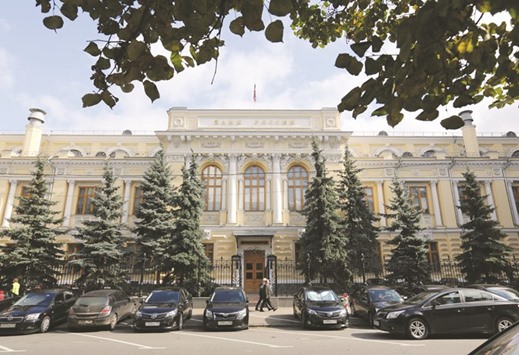
Pedestrians pass the entrance to the headquarters of Russia’s central bank. Russia’s GDP will expand as much as 1% next year after a drop of 0.5% to 0.7% in 2016, according to the central bank estimation.