


The fortunes have reversed for UK bank shares a little more than four months after Brexit spurred their worst slump since 2009.
A gauge tracking lenders in the FTSE 350 Index has rallied twice as much as the broader market since a June low following the referendum. Gains of about 40% or more in HSBC Holdings and Barclays, which get more than half their revenue outside the UK and account for about 70% of the lenders’ measure, have helped lift bank valuations from their lowest since 2009.
While global financiers have warned that losing single-market access to the European Union may put thousands of jobs and billions of pounds in revenue at risk, investors for now are focused on the benefits of a weak sterling and better-than- forecast economic data.
Speculation of another rate cut by the Bank of England is waning, just as optimism grows the European Central Bank’s actions will help improve profitability at lenders.
“It’s time to reassess how negative to be on UK banks,” said Ken Odeluga, a market analyst at brokerage City Index in London. “There are challenging times ahead, but the weak pound has absolutely been working out well for HSBC, while the better economic data has enabled banks exposed to the UK to defy expectations.”
The recent rally has pushed the valuation of members in the FTSE 350 Banks Index to 0.8 times the value of their assets, near the highest since January, as a rebound in 10-year gilt yields eased worries about profit margins. Banks benefit from a steep yield curve because they can borrow cheap, short-term cash and lend it out at higher, long-term rates.
Analysts project earnings at UK firms will rise at least 10% in each of the next two years, after a slump of about 19% in 2016. Barclays last week reported a jump in bond-trading revenue that topped estimates, while Lloyds Banking Group rose after saying it expects to maintain lending margins next year.
The two stocks make up about a third of the FTSE 350 Banks Index. HSBC, which has a 55% weighting on the gauge, releases results on November 7. Barclays and HSBC rebounded 40% or more from the market low that followed the secession vote through Tuesday, while Lloyds rose 10%, though it still trades below its price before the referendum. Royal Bank of Scotland Group, up 7.1% since the June bottom, is the biggest laggard in the lenders’ index, which dropped 1.3% in London.
In the longer term, a so-called hard Brexit may put the country’s lenders at risk of giving up passporting rights, which allow financial companies to sell services freely around the EU. Prime Minister Theresa May has pledged to trigger negotiations to exit the bloc by March, and a minister in her government said last month lenders will probably lose those privileges.
Barclays is cutting 25% of its London office space and said last week it’s evaluating options following the vote.
That didn’t stop bulls from sending banks higher for a third month in four, helping them briefly erase an annual drop that exceeded 25% as of June. With data on consumer confidence and gross domestic product signalling the economy is holding up, traders are pricing in a greater chance of the BoE raising rates in the second half of 2017 than cutting them.
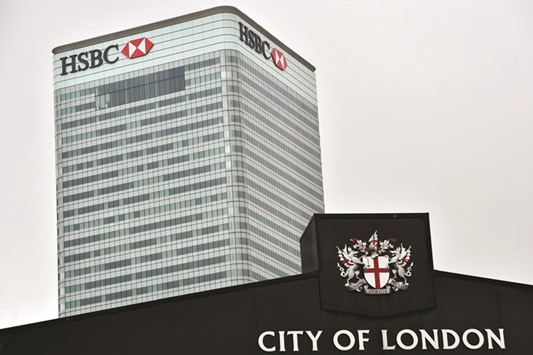
HSBC’s headquarters is seen London. Gains of about 40% or more in HSBC and Barclays have helped lift bank valuations from their lowest since 2009.