


South Korea’s economic growth is expected to hit the central bank’s 2.7% forecast this year, with third quarter GDP data showing the economy would have grown faster were it not for the setbacks suffered by Samsung Electronics Co Ltd and Hyundai Motor Co.
“When you take away the effects from Samsung and Hyundai, third-quarter growth was considerably better than expected,” said Chung Kyu-il, a director at the Bank of Korea.
A senior finance ministry official told Reuters later in the day the Samsung Galaxy Note 7 issue alone likely knocked 0.1 to 0.2 percentage points from third quarter growth.
Gross domestic product rose a seasonally adjusted 0.7% over July-September versus the second quarter, the Bank of Korea estimated yesterday, ticking down from a 0.8% quarterly rise.
With growth on track, the central bank is more likely to observe than act on monetary policy while looking out for a pending US
Federal Reserve rate hike expected by year-end.
Both Chung and the ministry official agreed that fourth quarter growth would also be affected by Samsung’s decision to discontinue production of its fire-prone Galaxy Note 7 smartphone, although the economic impact from lost manufacturing was nearly all reflected in the third quarter.
Manufacturing overall fell 1% in the third quarter, with Samsung’s smartphone crisis and the worst-ever strikes at Hyundai Motor nearly wiping out the second quarter’s 1.2% rise in factory output. Despite the strikes ending, there will not be an immediate jump in manufacturing in the fourth quarter, BoK director Chung said, although the central bank’s forecast will be achievable as long as sequential GDP growth hits 0.1% or higher next quarter.
ING economist Tim Condon said calls for monetary easing may shift to seek fiscal expansion as central bank rate cuts have resulted in heavy household debt growth, reduced consumption, and inventories piling up at manufacturers.
Most analysts see another rate cut early next year, but Kim Doo-un at Hana Financial Investment said Tuesday’s data would encourage the central bank to keep rates on hold in the near term. The median forecast in a Reuters survey of 19 analysts was for South Korea to post growth of 0.6 % in the third quarter in sequential terms.
In annual terms, GDP rose 2.7% in the third quarter, down from a 3.3% rise in the second quarter and marking its slowest growth since April-June of 2015.
Construction investment saved Q3 growth as expected, rising 3.9% in sequential terms and picking up from 3.1% growth in the June quarter.
Construction jumped 4.4% over the same period, speeding up from a 1% gain in the second quarter.
Services rose 1% in the September quarter from the previous three-month period, also better than a 0.6% gain in the second quarter, thanks largely to government efforts to launch nationwide retail sale events to pry open wallets. Capital investment slipped 0.1%, down from 2.8% growth in the previous quarter.
The Bank of Korea cut its policy interest rate by 25 basis to 1.25% in June, its eighth cut since starting this easing cycle in mid-2012.
The government has been churning out supplementary budgets nearly every year since then to help keep the economy afloat.
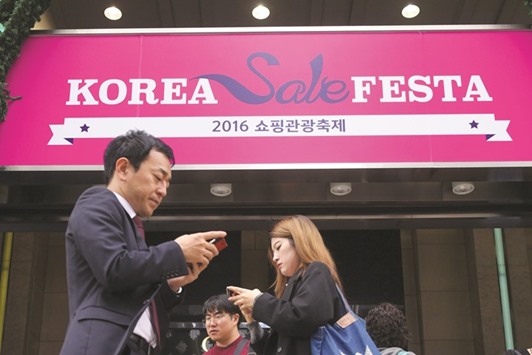
People walk past a commercial sign at a shopping district in Seoul. South Korea’s gross domestic product rose a seasonally adjusted 0.7% over July-September versus the second quarter, the Bank of Korea estimated yesterday.