


Indian armed forces are prepared to take on any challenge, Indian Air Force (IAF) chief Arup Raha said yesterday, adding there has been enough discussion on the ‘surgical strikes’ across the Kashmir border, but the military will not talk about it.
“There has been so much discussion on this issue in the country; every section of society is giving opinion on this issue. ... The armed forces are supposed to deliver the result that the nation expects. We are not going to talk about it; we will just deliver,” Raha said at the Hindon Air Base on the 84th Air Force Day.
Raha is also the chairman of the Chiefs of Staff Committee.
Responding to a question on the surgical strikes and politicisation of the issue, Raha refused to comment on the Indian Army action across the Line of Control on the night of September 28-29 and related issues.
The surgical strikes came in the wake of the September 18 terrorist attack on an army camp in Uri town of Jammu and Kashmir, in which 19 soldiers were killed.
In his speech at the Air Force Day function earlier, Raha referred to both the Pathankot and Uri attacks in Punjab and Kashmir respectively.
“Terrorist attacks at Uri (army camp) and Pathankot (IAF) base show the troubled times we are living in,” Raha said.
Asked to comment on the issue later, the air force chief said India is learning lessons every time something happens.
“We are getting smarter and smarter; we are learning lessons every time something happens. I think we are very well prepared now to face any such contingency,” he said.
“The armed forces are well prepared to take on any sub-conventional threat. We have had one or two cases... A determined terrorist can always get the better of people but the aim is to prevent it... the deterrence. We should be able to detect any such attack right in the beginning so that we can neutralise them (terrorists) before they cause any damage,” the IAF chief said.
Raha, in his speech, said that India is being seen as a “net security provider” in the Indian Ocean region.
Earlier in the day, in a message on newly-created official Facebook page of the IAF, Raha said the IAF is prepared to deal with “any challenge” in “the most befitting manner.” “We continue to train to take up any threat and are fully prepared to undertake any challenge in most befitting manner,” the IAF chief said.
The official Facebook page of the IAF has been named ‘Indian Air Force, Power to Punish.’
Asked if the name was an indication, Raha said in a lighter tone: “That was put up on our Facebook page, power to punish, that is a fact, but I think we will make it power to serve the nation.”
The Air Force Day commemorates the establishment of the armed force on October 8, 1932.
l As the guardians of the skies to secure the air space during peace and war, the IAF warriors and their flying machines are kept tip-top at its Aircraft and Systems Testing Establishment (ASTE) in Bengaluru.
“Our test crew conducts flight trials of the various aircraft and tests their armaments here (ASTE) before inducting them into our fleet for operations and endurance in peace and war times,” said the Commandant, Air Vice Marshal Sandeep Singh.
As one of the six of its kind the world over, the 44-year-old ASTE is the IAF’s only test centre in the country for field trials of its fighters, transport aircraft and helicopters that are indigenous or imported from global aerospace majors.
The other five such test centres for military aircraft and weapon systems are in Britain, France, Russia and the US (two).
“In the recent times, Rafale and Typhoon multi-role medium combat aircraft (MMRCA) were short listed after their field evaluations and flight tests on 750 quantitative and quality requirements by our test pilots and engineers in all-weather conditions and situations,” said Group Captain and Chief Test Pilot S Chaki.
The other four fighters in contention were F-16 Falcon of Lockheed Martin, F-18 Hornet of Boeing, Gripen of Swedish Saab and Russian MiG-35.
Though Rafale of Dassault Aviation was selected over Eurofighter Typhoon as the lowest bidder, India and France on September 23 signed a €7.87bn deal to buy 36 of fighter jets equipped with the latest missiles and weapons systems.
As the world’s fourth largest air force, the IAF operates various lean and mean flying machines, including Sukhoi-30, Mirage 2000, Jaguar, MiG-21, MiG-29, Light Combat Aircraft (LCA) Tejas, Advance Light Helicopter Dhruv, Mi-17, C-130 and C-17 aircraft, keeping pace with time and technological advancements.
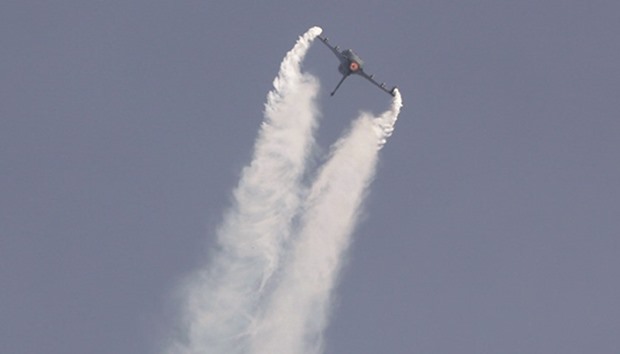
An Indian Air Force (IAF) light combat aircraft u201cTejasu201d performs during the Indian Air Force Day celebrations at the Hindon Air Force Station on the outskirts of New Delhi yesterday.