


Tai Hui is experiencing deja vu. China’s surge in home prices reminds JPMorgan Asset Management’s chief Asia market strategist of last year’s stock market mania. Spiralling leverage and implicit state support are among the common denominators, he says. Shanghai property values jumped 31% in August from a year earlier, the latest data show. In 2015, a 60% rally in the city’s equities through June 12 was followed by a $5tn rout.
Deutsche Bank Group warned last month that China’s housing market is in a bubble, while Goldman Sachs Group said this week it sees growing risks across the real estate industry. Home prices started to take off last year in the wake of the stock market crash after the governments eased curbs on property purchases. In recent days, cities including Shenzhen have started re-imposing restrictions.
“It’s similar to the equity market where if you let things loose, it just runs like a stallion,” said Hui. “And then you have to really rein it back, then it’s like an ice bucket challenge. So you go through this extreme heat and cold. That’s not particularly good for the economy because then you’re going through very aggressive investment cycles.”
At stake is the government’s ability to channel funds trapped by capital controls into investments that can boost the economy without creating asset bubbles. Speculative buying of commodity futures earlier this year fuelled a boom that quickly unravelled, while a botched intervention to halt plummeting equities dented the credibility of policy makers and roiled global markets.
Just as the surge in stocks in the first half of 2015 enervated financial services and provided a fillip to an ailing economy, rampant demand for property is boosting the outlook for commodities and lifting the earnings outlook for construction- related firms. Profits of industrial companies jumped the most in three years in August, while factory output, investment and retail sales also beat analysts’ estimates.
Home prices started to climb after China eased mortgage policies and down payment requirements in March 2015 to arrest what was then a slide in prices. New curbs, such as higher deposits to limits on the number of homes people can buy, are proving ineffective given the easy access homebuyers have to leverage, said Wee May Ling, an investment manager at Henderson Global Investors.
Medium and long-term new loans, mostly mortgages, totalled 529bn yuan ($79bn) in August, while aggregate financing jumped to 1.47tn yuan, helping fuel a 39% jump in property sales by value in the first eight months. Private investment in fixed assets, meanwhile, stalled at 2.1% for a second straight month in the January through August period, matching a record low.
While HSBC Holdings says the overall level of China’s household debt remains low, Deutsche Bank said it sees “clear sign of a bubble” in property - one that will end in a major correction in two years’ time. Just like last year’s equity boom, China is using credit growth to boost the economy, Zhiwei Zhang, chief China economist at Deutsche Bank, wrote in a report on September 28.
“The main concern about China is that it has reverted back to the old model in terms of stimulating growth by monetary and credit side,” said Philipp Baertschi, Zurich-based chief investment officer at Bank J Safra Sarasin. To be sure, there are signs policy makers are acting to restrain growth in debt. The People’s Bank of China has kept its benchmark lending and deposit rates on hold for nearly a year and banks’ reserve ratios unchanged since February, failing to deliver the additional cuts private economists had forecast in earlier surveys. The central bank has also used longer-term tenors in the open market to drive up funding costs in a bid to rein in leverage.
Still, any winding down of debt brings its own risks. “We saw the stock market tumble in 2015 from June throughout the second half, triggered by the unwinding of leverage after margin lending reached record highs,” said Jing Ulrich, vice chairman of Asia Pacific at JPMorgan Chase & Co “Today, an alarming sign is that leverage is also building in the property market.”
While analysts aren’t predicting home prices to collapse in the manner of the stock market, last year’s experience shows the risk of allowing a leverage-fuelled boom to spiral out of control.
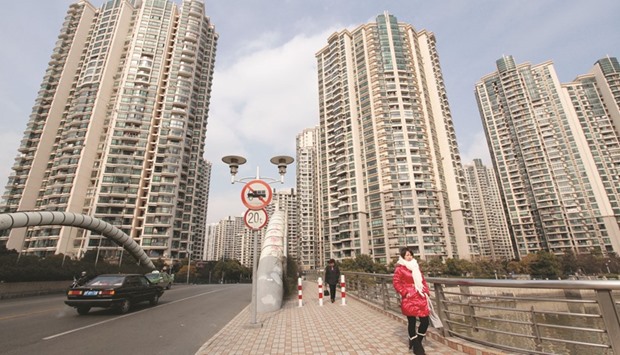
Women walk in front of a housing complex in Shanghai. Deutsche Bank warned last month that China’s housing market is in a bubble, while Goldman Sachs said it sees growing risks across the real estate industry.