


The US natural gas market is on an unsustainable trajectory as consumption grows rapidly while domestic production is falling.
Gas production was down nearly 4% in July compared with the same month a year earlier, according to data published by the Energy Information Administration.
Marketed dry gas production amounted to 2,212bn cubic feet in July 2016 compared with 2,304bn cubic feet in July 2015. Low gas prices have discouraged drilling of gas-rich formations and caused production to start falling after rapid growth in 2014 and 2015.
There were just 86 rigs drilling for gas at the end of July, down from 209 at the end of July 2015, according to oilfield services company Baker Hughes.
Drillers are becoming more efficient, targeting a small number of super wells that produce enormous amounts of gas, but higher productivity has not been enough to offset the drilling downturn.
At the same time, consumption is hitting record levels, especially for electricity generation, where cheap gas has captured market share from coal.
Power producers burned a record 1,184 bn cubic feet of gas in July, 9% more than in July 2015, and easily beat the previous record of 1,118bn cubic feet set in July 2012.
Some of the increase in gas consumption has been driven by unusually high temperatures and air-conditioning demand this summer.
Temperatures across the most populated areas of the United States have been consistently above normal since the end of May.
But gas consumption has been unusually high even once the high temperatures and air-conditioning demand are taken into account.
Power producers’ gas consumption was almost 6% higher in July 2016 than in the previous peak in July 2012 even though population-weighted cooling degrees days were nearly 5% lower.
Climate policy is encouraging power producers to retire old and inefficient coal-fired generation plants and replace them with more efficient and cleaner burning combined cycle gas units.
Low gas prices have accelerated the switch by encouraging power producers to reduce run rates at coal units and maximise run rates at gas-fired plants instead.
Power producers have burned their way through most of the surplus of gas left over at the end of the record warm winter 2015/16.
Working gas stocks in underground storage stood at 3,600bn cubic feet on September 23, an increase of just 90bn cubic feet or 2.6% compared with a year ago.
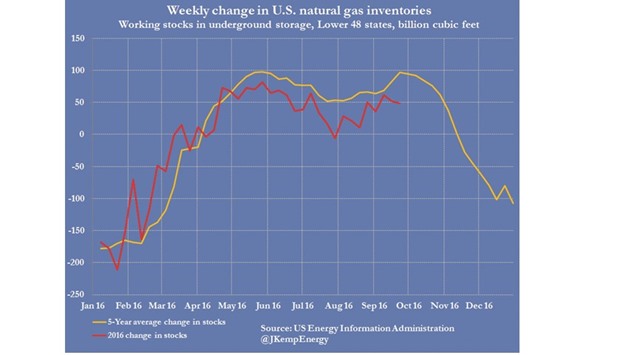
The year-on-year storage surplus has shrunk from 1,017bn cubic feet or 70% back on March 23, according to data from the Energy Information Administration. Gas stockpiles have shown below-average increases for 21 consecutive weeks as high air-conditioning demand, strong underlying gas consumption and falling gas output have rebalanced the market.
Within the next 2-3 weeks, US gas stocks are likely to decline below year-ago levels, as stocks continue to build slowly. Winter of 2016/17 will almost certainly be colder than the record warm winter of 2015/16, ensuring higher gas consumption for heating, though how much colder remains uncertain.
But with gas stocks normalising, supply falling, demand increasing, and more gas-fired power plants scheduled to start up over the next 12 months, prices will have to rise to moderate the power burn and spur more drilling in 2017.
John Kemp is a Reuters market analyst. The views expressed are his own.
FALLING