


If you pay with plastic at the checkout, chances are you’ve seen the logo of San Jose, California-based VeriFone Systems Inc You may soon see a Chinese one instead.
VeriFone, the largest maker of payment readers in the US and the second-largest in the world, is losing ground to rivals offering more mobile options or lower prices. The company’s share of the global payment-terminal market fell to 13.7% last year from 16.1% in 2014, according to a new analysis from the Nilson Report, a newsletter that tracks the payment industry. In the US, its share has eroded more slowly, to 39.4% from 40.5%, the report found.
The new findings mark the latest piece of bad news for a company struggling to pull out of a tailspin. Waning demand for new chip-card terminals among small US businesses and device-certification delays forced VeriFone to cut forecasts this year, sending shares plummeting 43% and prompting takeover speculation from analysts and even its former chief executive. The company, slow to embrace a shift to mobile devices, is now trying to boost sales with new products and services, like Carbon, a portable counter-top terminal designed for cafes, restaurants and retail shops that requires minimal space.
“VeriFone has got to get to a place where it’s doing much more with mobile and tablet devices, and then find out what the growth opportunities are beyond selling hardware,” David Robertson, publisher of the Nilson Report, said in an interview.
The new report highlights a troubling trend for the beleaguered company. Chinese manufacturers Fujian Newland Payment Technology Co Ltd and Pax Global Technology Ltd are taking share of the payment-terminal market by leveraging relationships with local companies in Asia that supply card readers to businesses. In Europe, North America and elsewhere, Fujian and Pax are undercutting both VeriFone and global leader Ingenico Group on price.
“We’re very confident in the role Verifone is going to play in the future of payments and commerce, and we continue to be more and more relevant everywhere and to everyone we serve,” VeriFone spokesman Andy Payment said in an e-mail. “We remain focused on delivering our next-generation solutions, which will help our clients benefit from the increased connectivity of global commerce.”
Ingenico, whose global market share fell to 22.5% from 26.6% according to the Nilson data, had no immediate comment. Its shares have also tumbled this year, though the 32% decline is less than VeriFone’s, with investors favouring Ingenico’s higher profitability and lower exposure to the US market.
To be sure, VeriFone still maintains its position as one of the most prominent manufacturers of payment hardware in the world. Chinese retailers are in the process of accepting European-style chip cards, meaning Fujian and Pax may enjoy a short-lived sales spike at the expense of market leaders.
VeriFone has also cut jobs and streamlined operations, part of a restructuring of the business by chief executive officer Paul Galant. That broader effort is not yet complete, Jeffrey Bronchick, co-founder of Cove Street Capital LLC, a VeriFone investor, said in an interview.
“It’s better,” Bronchick said of the company’s efforts. “But it’s still very, very messy, and that’s something that current management didn’t quite understand until this slowdown.” To keep things simple and free up cash, the company should have only one open operating system, instead of the handful it supports now, Bronchick added.
The company’s debt continues to be a concern as well. Moody’s Investors Service rates VeriFone as Ba2, meaning a substantial credit risk. At the end of July, the company had $907.8mn in long-term debt, the bulk of which is due in 2019, according to Morgan Stanley. S&P has a BB rating on VeriFone, with a stable outlook.
“If the operating performance continues to decline, that will challenge our credit profile,” said Raj Joshi, a senior analyst at Moody’s Investors Service, which rates VeriFone as stable.
Given its situation, VeriFone could become an acquisition target, perhaps for private-equity firms, said Gil Luria, an analyst at Wedbush Securities Inc. Former CEO Doug Bergeron has already floated that possibility, saying he would consider orchestrating a takeover if the stock price fell to around $12 a share.
A bigger problem for VeriFone in the long term may be a shift that could happen in the industry toward the so-called razor-blade model, where profits rely on customers repeatedly buying complementary services. If VeriFone’s competitors increasingly sell terminals cheaply in the hope of making up the money on a subscription basis later, that could cut into VeriFone’s margins, said James Faucette, an analyst at Morgan Stanley.
If providers were to move completely to such a model, Faucett said, VeriFone may see “persistent increased pricing pressure on terminals as competition manoeuvres for future services.”
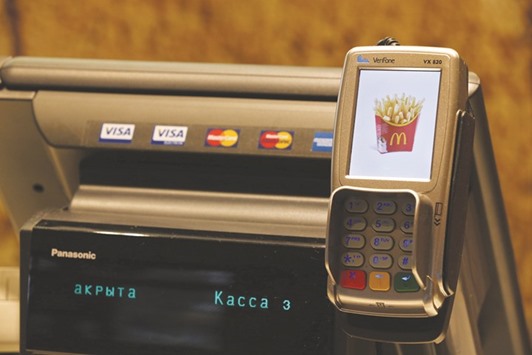
A photograph of french fries is displayed on the screen of a Verifone Systems card payment device as the logos of Visa and Mastercard sit on a till inside a McDonald’s fast food restaurant in Moscow (file). VeriFone, the largest maker of payment readers in the US and the second-largest in the world, is losing ground to rivals offering more mobile options or lower prices.