


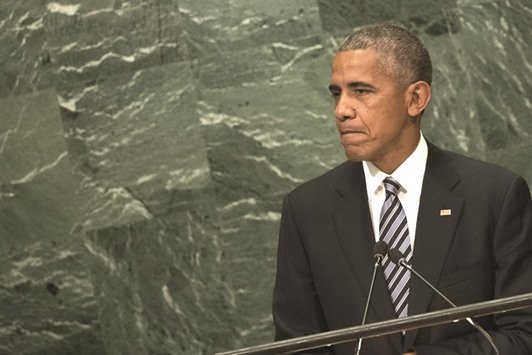
“There’s no ultimate military victory to be won, we’re going to have to pursue the hard work of the diplomacy that aims to stop the violence and deliver aid to those in need,” Obama told the United Nations.
Obama offered tough words for Russia’s support of the Syrian regime as a ceasefire agreement fell apart as well as for Moscow’s incursion in Ukraine.
“We see Russia attempting to recover lost glory through force,” Obama told the UN General Assembly.
Without specifically mentioning Russian President Vladimir Putin or other world leaders, he denounces “strongmen” who seek to maintain power by either perpetual political crackdowns at home or creating conflicts abroad.
His comments came hours after the Syrian military declared the ceasefire over and 18 UN aid trucks were destroyed as they tried to bring relief to war-ravaged citizens near Aleppo.
Syria and Russia denied striking the convoy, with Moscow suggesting it may have caught fire.
Obama’s secretary of state John Kerry insisted hopes for a ceasefire remain alive after meeting his Russian counterpart and key powers with a stake in the civil war.
In brief remarks to reporters as he left a New York hotel after a meeting of the International Syria Support Group, Kerry said talks would reconvene later this week.
“The ceasefire is not dead,” Kerry insisted.
United Nations envoy Staffan de Mistura confirmed that there was still hope of reviving the ceasefire, but admitted that delegates agreed it was in danger.
The 23-nation ISSG, chaired by Kerry and his Russian counterpart Foreign Minister Sergei Lavrov, met in New York on the sidelines of the UN General Assembly.
The talks were brief and, participants said, tense.
“The mood is that nobody wants to give this thing up,” Britain’s Foreign Secretary Boris Johnson told reporters.
“Quite frankly the Kerry-Lavrov process is the only show in town and we’ve got to get that show back on the road.”
His French counterpart Jean-Marc Ayrault agreed that the meeting had been tense but argued other countries should now help Moscow and Washington overcome their differences.
“It was a fairly dramatic meeting, the mood was gloomy.
Is there hope? I can’t answer that yet, but we should do everything we can,” he said.
“The US-Russian negotiation has reached its limit.
There’s a lot left unsaid.
The Russians and the Americans can’t do it alone.”
The ministers are in New York for the week to attend the UN General Assembly and officials said they would try to get together again to talk about Syria.
In his final address to the UN General Assembly in New York, Obama contrasted the economy of South Korea with “the wasteland of North Korea [that] shows that central, planned control of the economy is a dead end”.
North Korea’s recent nuclear tests illustrate the importance of the global community and unified reaction, he says, stressing Pyongyang “must face consequences”.
Obama called yesterday for the international community to step up aid for refugees.
“We have to open our hearts and do more to help refugees who are desperate for a home,” he said in his final address to the UN General Assembly, adding that nations should stand by pledges of increased assistance “even when the politics are hard”.
“We have to imagine what it would be like for our family, for our children.
If the unspeakable happened to us,” Obama said. “And we should all understand that ultimately our world will be more secure if we are prepared to help those in need and the nations who are carrying the largest burden with respect to accommodating these refugees.”
Obama said all sides should welcome pledges of assistance that were made at the ongoing UN General Assembly meeting in New York.