


Russia and a war monitor said the Syrian army had begun to withdraw from a road into Aleppo yesterday, a prerequisite for pressing ahead with international peacemaking efforts as the government and rebels accused each other of violating a truce.
However, insurgent groups present in Aleppo said they still had not seen the army withdrawing from the Castello Road, needed to allow aid deliveries into the city, and would not pull back from their own positions near the road until they did.
The Pentagon said it could not confirm reports of a withdrawal but US State Department spokesman Mark Toner said that the ceasefire was holding “by and large”, adding that both Washington and Moscow believed it was worth continuing.
But there were growing accusations of violations by each side, with a Syrian military source saying the rebels were responsible for dozens of breaches including gun, rocket and mortar fire in Damascus, Aleppo, Hama, Homs and Latakia.
The rebels said Syrian army jets had struck in Hama and Idlib, and used artillery near Damascus.
The Syrian Observatory for Human Rights, a British-based war monitor, said that while it had documented attacks by both sides, relative calm had persisted in most areas and it had not recorded any civilian deaths for a third consecutive day.
Control of the Castello Road is divided between the government and rebels who have been battling to topple President Bashar al-Assad for more than five years.
It has been a major frontline in the war.
“The Syrian army ... began the staged withdrawal of vehicles and personnel from the Castello Road to ensure the unimpeded delivery of aid to eastern Aleppo,” said Lieutenant General Vladimir Savchenko, head of the Russian Reconciliation Centre in Syria in remarks broadcast on state television.
The Observatory said the army had started to withdraw from positions on the road, but that Russian troops, whose air force has helped Damascus to blockade rebel-held Aleppo, had replaced it.
An official in an Aleppo-based Syrian rebel group said late yesterday that the army had still not pulled back.
“There is no withdrawal by the regime from the Castello Road,” Zakaria Malahifji, of the Aleppo-based rebel group Fastaqim, told Reuters.
The UN Syria envoy Staffan de Mistura said that the United States and Russia were expected to manage the disengagement of forces from the road, but also criticised Damascus for failing to provide permits needed to make aid deliveries to other areas.
The UN humanitarian adviser Jan Egeland said both the rebels and the government were responsible for delaying aid deliveries into Aleppo.
“The reason we’re not in eastern Aleppo has again been a combination of very difficult and detailed discussions around security monitoring and passage of roadblocks, which is both opposition and government,” he said.
In other areas, de Mistura was categorical about blaming the Syrian government, saying it had not yet provided the proper permits.
The Syrian government has said all aid deliveries must be conducted in co-ordination with it.
France, which backs the opposition, became the first US ally to publicly question the deal with Moscow, urging Washington to share details of the agreement and saying that without aid for Aleppo, it was not credible.
About 300,000 people are thought to be living in eastern Aleppo, while more than 1mn live in the government-controlled western half of the city.
Two convoys of aid for Aleppo have been waiting in no-man’s land to proceed to Aleppo after crossing the Turkish border.
If a green light was given, a spokesman for the UN Office for the Co-ordination of Humanitarian Affairs (OCHA) said the first 20 trucks would move to Aleppo and if they reached the city safely, the second convoy would then also leave.
The two convoys were carrying enough food for 80,000 people for a month, he said.
The United States and Russia have backed opposing sides in the Syrian war that has killed hundreds of thousands of people, forced 11mn from their homes, and created the world’s worst refugee crisis since the World War II.
Aleppo, Syria’s biggest city before the war, has been a focal point of the conflict this year.
Government forces backed by militias from Iran, Iraq, and Lebanon have recently achieved their long-held objective of encircling the rebel-held east.
Russia’s intervention a year ago in support of Assad has given it critical leverage over the diplomatic process.
Its ally, Assad, appears as uncompromising as ever.
He vowed again on Monday to win back the entire country, which has been splintered into areas controlled by the state, an array of rebel factions, the Islamic State group, and the Kurdish YPG militia.
Washington hopes the pact will pave the way to a resumption of political talks.
But a similar agreement unravelled earlier this year, and this one also faces enormous challenges.
Russia’s deputy foreign minister Gannady Gatilov said talks could resume at the end of September, but this was quickly rejected by George Sabra, an opposition negotiator, who said conditions on the ground were not yet good enough.
The United States and Russia are due to start coordinating military strikes against Islamic State and a group formerly known as the Nusra Front if all goes to plan under the deal.
But Russia said yesterday that the United States was using “a verbal smokescreen” to hide its reluctance to fulfil its part of the agreement, including separating what it called moderate opposition units from terrorist groups.
The defence ministry said only government forces were observing the truce and opposition units “controlled by the US” had stepped up shelling of civilian residential areas.
Rebels say Damascus has carried out numerous violations.
While the general lines of the agreement have been made public, other parts have yet to be revealed, raising concerns among US
allies such as France, which is part of the coalition attacking Islamic State in Syria and Iraq.
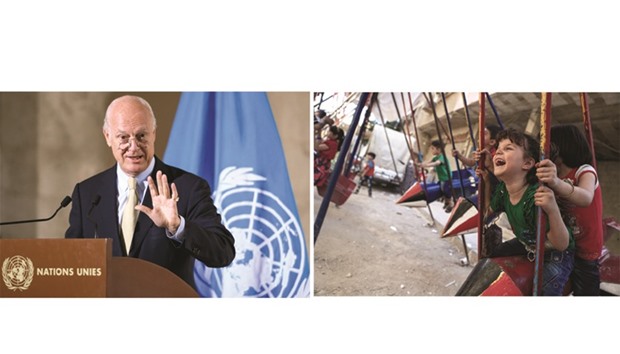
UN envoy de Mistura gestures during a press briefing following a meeting on Syria at the UN Offices in Geneva. Children play on swings, made from the remnants of exploded rockets in the rebel-held town of Douma, on the eastern edges of the capital Damascus. The United Nations has urged Syria’s government to allow immediate aid deliveries to hunger-stricken civilians after a fragile ceasefire was extended for 48 hours by Russia and the United States.