


When it comes to assessing demand for US soybeans, never underestimate the Chinese.
China’s penchant for the oilseed has mushroomed in recent years, complementing growth in the country’s livestock sector, particularly pork.
As the world’s largest soybean consumer, China will use over 40% more soybeans than the world will have in storage next year.
The United States just began its 2016-17 soybean marketing year, and China will have a big say in how much supply is left over at the close of next August.
The increasing likelihood of a record-large soybean crop in the United States, one of China’s key suppliers, may have at least temporarily masked some of the risk to the domestic balance sheet.
Analysts expect US soybean production to increase in Monday’s US Department of Agriculture supply and demand report, but they expect 2016-17 ending stocks to remain relatively unchanged near 330mn bushels.
Although this reflects that huge yields will be offset by increasing demand, there is the potential for demand to pull US soybean inventory even lower throughout the next year if China’s recent habits remain the same.
In 1996-97, China imported just over 2mn tonnes of soybeans and a decade later this figure had climbed to 29mn tonnes.
The US Department of Agriculture has projected China to import 87mn tonnes in the 2016-17 marketing year, which will begin on October 1.This is the equivalent of 3.197bn bushels, and for comparative purposes, the United States produced 3.929bn bushels of soybeans last year.
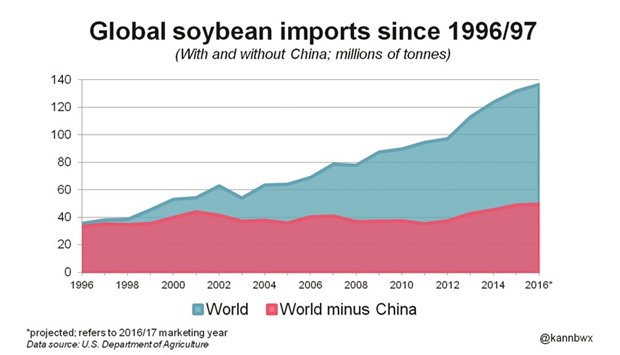
To put China’s massive soybean demand trend into perspective, the East Asian country now accounts for nearly two-thirds of the world’s imports of the oilseed.
When subtracting China from the mix, the global soybean import trend over the past 20 years is practically rendered flat.
As the world’s two biggest soybean producers, the United States and Brazil are naturally China’s primary suppliers.
Over the last couple of years, the two countries have been responsible for 85 to 90% of China’s total soybean imports.
Not surprisingly, China buys the majority of soybeans that Brazil and the United States export. In 2014-15, some 72% of Brazil’s shipments were imported by China, and the corresponding figure for the United States was 59%.
The United States supplies the first half of China’s marketing year while Brazil takes over the second half.
Peak soybean shipments from the United States to China occur around December, and Brazil will peak between April and May.
In May 2014, the US Department of Agriculture placed Chinese soybean imports for the new 2014-15 marketing year at 72mn tonnes.
At the conclusion of the season in late 2015, China had actually imported 78.35mn tonnes.
In May 2015, the initial estimate for the nearly completed 2015-16 year was 77.5mn tonnes.
As of last month, USDA expected that China will import 83mn tonnes of soybeans in the current marketing year.
The lesson? China’s soybean appetite seems limitless, as its annual imports have been significantly underestimated in the past two years.
The difference in the initial and final Chinese soybean import figures from 2014-15 was 233mn bushels, very close to the 255mn bushels that the United States is estimated to have left over after its recently concluded 2015-16 marketing year.
China may not reach 83mn tonnes in 2015-16, though, as Shanghai-based analyst JC Intelligence Co (JCI) said on Thursday that September soybean imports may fall below 6mn tonnes.
This would be well below last September’s 7.3mn tonnes.
Through August, China has imported 76mn tonnes of soybeans.
But even an optimistic assumption of 6mn tonnes imported during September would land the final volume about 6% higher than the initial assumptions — a difference of 165mn bushels.
The brief slowdown in imports should be only temporary, according to JCI.
Chinese demand for US soybeans received a boost last week as a delegation of buyers signed agreements to purchase nearly 4mn tonnes at a signing ceremony in Indianapolis.
In the United States, about 41% of the expected soybean export volume for 2016-17 has been booked through August 25.
This rate is very comparable to previous years and implies that US soybean shippers are about to get pretty busy in a couple of months, especially if sales continue on a strong course.
Maybe it is hard to imagine that China’s potential 87mn tonne haul could edge much higher over the next year or so, but then again, it was probably difficult to fathom a volume over 30mn tonnes just a decade ago.
Of course, Brazil’s harvest early next year will be crucial in just how much of the oilseed China can acquire, as well as the timing and the source.
But the United States will take the leading role in supplying China with soybeans for at least the next six months, and it is a good idea to pay attention because increasing Chinese demand could cut down US supply in a jiffy.
Karen Braun is a Reuters market analyst. The views expressed are her own.
CHINA