


India’s inflation is accelerating and a hawkish new central bank chief has little room to cut interest rates. So why are rupee sovereign bonds emerging Asia’s best performers over a month?
The reason is about Rs900bn ($13.4bn) in Reserve Bank of India cash infusions since April and the possibility of another Rs900bn via open-market bond purchases by March 31, according to HSBC Holdings.
When Urjit Patel takes his post today, he will be driven by a “neutral systemic liquidity” goal he designed with his boss Raghuram Rajan in April, meaning periods of cash shortages are balanced with surpluses.
“There is a paradigm shift in the way that monetary policy is operating, as the central bank uses the liquidity tool over interest rates,” said Suyash Choudhary, Mumbai-based head of fixed income at IDFC Asset Management Co that oversees about Rs543bn of assets.
“The promise of bond purchases has provided the biggest shield to the market.”
The Rajan-Patel duo introduced the policy seeking to pass on the benefits of the central bank’s five interest-rate cuts since early 2015 more widely into Asia’s third-largest economy that saw growth slow last quarter.
Benchmark sovereign yields have fallen to seven-year lows; banks’ treasury incomes have swelled, companies are finding it cheaper to raise funds from the bond market and the government’s borrowing costs have fallen.
Rupee sovereign bonds returned 1.5% in the past month even as data mid-August showed consumer-price gains breached the 6% upper bound of the central bank’s target range. Benchmark 10-year notes capped their biggest three-month rally since early 2015 on Wednesday, with the yield dropping 36 basis points since the end of May. The 10-year yield rose one basis point to 7.12% in Mumbai on Thursday while the rupee was little changed at 66.96 per dollar, after data late Wednesday showed India’s gross domestic product rose 7.1% in the April-June period from a year earlier. That missed the 7.6% median estimate in a Bloomberg survey.
Citibank is predicting more bond gains as it sees the recent inflation spike cooling toward the end of the year and the global hunt for yield supporting demand for debt, Badrinivas Nallan Chakravarthy, Mumbai-based head of local markets treasury at the US bank, said in an interview last month.
HSBC’s Hong Kong-based strategist Himanshu Malik predicts the yield will drop to 6.5% by December 31, a level last seen in mid-2009.
“The factor that’s been most instrumental in the market rally has been the RBI’s bond purchases,” said Manish Wadhawan, HSBC’s Mumbai-based head of interest-rate trading. “That created enough liquidity in the system.”
Despite falling 64 basis points in 2016, India’s benchmark 10-year bond yield is still the highest among major Asian markets.
The improving cash supply has also helped drive interbank costs and short-term money-market rates lower.
That’s driving “highly-rated” companies to borrow from the commercial-paper market, Rajan said in a speech in Mumbai last week, as Indian banks remain reluctant to cut lending rates in the wake of mounting bad loans.
Three-month commercial paper rates fell to the lowest level in six years last week.
“The RBI’s change of its stance on liquidity has brought about transmission of lower rates across market-traded instruments,” said Ananth Narayan, Mumbai-based regional head of Asean & South Asia financial markets at Standard Chartered.
Low global yields and the rupee’s stability have further boosted the “attractiveness of Indian debt,” he said.
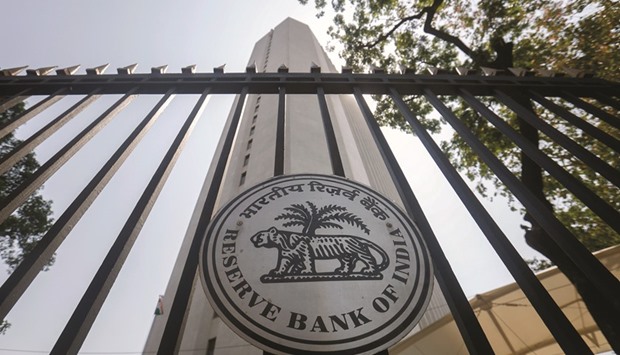
The Reserve Bank of India logo is displayed on a gate at its headquarters in Mumbai. Despite falling 64 basis points in 2016, India’s benchmark 10-year bond yield is still the highest among major Asian markets.