


The UK must set strict timelines for Volkswagen to recall tainted diesel vehicles and compensate their owners, a parliamentary committee said, adding Europe’s second-largest auto market to the list of countries demanding a definitive resolution from the German car maker.
VW is “only just beginning to recall cars in the UK,” where about 1.1mn vehicles were found to contain software that rigged emissions tests, parliament’s environmental audit committee said in a report yesterday. It criticised the UK Department for Transport, Serious Fraud Office and Competition and Market Authority for failing to decide on penalties against the German carmaker almost a year since the scandal was exposed.
“There’s been a worrying inertia from ministers in tackling the VW scandal, and they should decide whether to take legal action,” Mary Creagh, the committee’s head, said in a statement.
“It’s been almost a year since we discovered VW had fitted cars with cheat devices, but government has still to decide what action to take against the company.”
Volkswagen revealed in September 2015 that about 11mn of its diesel-powered vehicles worldwide were equipped with software designed to switch on full pollution controls only during official emissions tests, setting off a global backlash.
Settlements with US authorities and owners will cost the company $16.5bn. The carmaker has also been fined in South Korea, where sales of 80 of its models have been banned. Regulators in Germany have been approving recall terms, which apply across Europe.
The UK committee’s recommendations are part of a larger review of automotive policy, which the parliamentary group said is set to miss targets for reducing vehicle emissions in the country.
Government must underwrite the risk of procuring ultra-low emission vehicles, while subsidising charging points at workplaces and introducing a grant for electric and low-emission taxis, the committee said. Incentives should also be given to the likes of Nissan Motor Co, Honda Motor Co and Toyota Motor Corp to produce next-generation electric cars in the UK, it said.
The UK’s current approach contrasts with Germany’s, where parliament has drafted legislation that widens consumer incentives to adopt electric vehicles through tax breaks as well as cash incentives of €4,000 ($4,500) for purchases of all-electric cars and €3,000 for hybrid models. The UK’s air-quality targets for 2010 will now only be met by 2020 because of belated plans to tackle pollution, according to the parliamentary report. The decision to quit the European Union means there is a “material risk” to meeting those targets, the committee said. Of 43 zones across the UK, 38 are currently in breach of legal air-quality limits, including London, Manchester, Bristol and Cardiff.
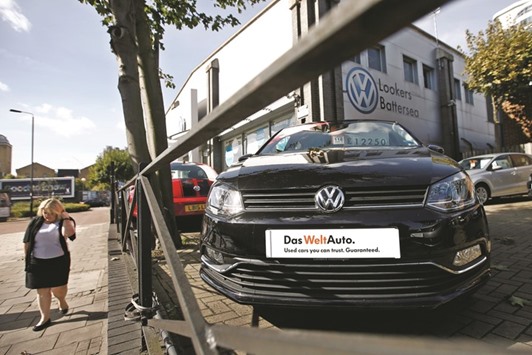
A pedestrian walks past Volkswagen dealership in London. The UK parliament’s environmental audit committee has criticised the Department for Transport, Serious Fraud Office and Competition and Market Authority for failing to decide on penalties against the German carmaker almost a year since the scandal was exposed.