


As China’s sovereign bond yields tumble to decade-lows, investors are piling into the most defensive part of the stock market in search of returns.
The Shanghai Stock Exchange Dividend Index, composed largely of banks, utilities and expressway operators, has rallied 5.6% in the past month and climbed to the highest level versus the Shanghai Composite Index in a year on August 12. The 50-member gauge returns 3.6% in dividends, compared with 2.7% for 10-year sovereign debt and 2% for the benchmark equity measure.
While that avenue is closing, with the payout offered by the index of high-paying stocks over 10-year government bonds falling to the lowest level this year, China Asset Management Co says the rising number of risk-averse institutional investors will drive demand for equities with more stable returns. “Gains by dividend stocks reflect the pressure for asset allocation against the backdrop of an asset famine,” said Dai Ming, a money manager at Hengsheng Asset Management Co in Shanghai. “Investors have been chasing safe assets when bond yields are falling and the economy may slow further.”
The stocks with the highest yields offered on the index are Daqin Railway Co, Zhengzhou Yutong Bus Co and Huaneng Power International Inc, according to data compiled by Bloomberg.
While banks including Industrial & Commercial Bank of China and Agricultural Bank of China return yields of more than 5%, rising bad loans threaten future payouts.
The nation’s largest state-controlled lenders cut their dividends for last year, underscoring what Bank of China’s president described in March as a “new normal” of low profit growth for the lenders. ICBC had 179.5bn yuan ($27bn) of nonperforming loans as of December, an increase of 44% from a year earlier. Large companies with stable and relatively high dividends will continue to lure risk-averse investors, who will play an increasingly influential role in the stock market, according to China Asset Management. It’s a familiar situation to anyone who’s been watching US equities lately, where high-dividend bond surrogates like utilities and phone companies have led the way in 2016, and to a lesser extent developed markets worldwide.
“Inflows in the next few years will largely come from institutions with a low-risk preference, such as insurers, pensions and inflows from stock connect programs,” said Xuan Wei, Beijing-based chief strategist at China Asset Management, the nation’s second-largest money manager with 515.7bn yuan under management at the end of June. “These funds would shun growth stocks with high valuations, and prefer blue chips with high dividends.”
The Shanghai Stock Exchange Dividend Index dropped 0.1% at the close.
Valuations of such stocks are lower than those for the benchmark equity gauge. The dividend measure trades at 10.5 times reported earnings, compared with 17.1 times for the Shanghai Composite Index.
HFT Investment Management Co is looking for stocks with above-average payouts on expectations that bond yields will continue to drop as the economy slows.
The 10-year sovereign yield will fall to 2.5% this year, according to a survey of 24 traders and analysts by Bloomberg. Recent data on industrial production, fixed-asset investment and credit growth all missed estimates. The benchmark yield has declined 12 basis points this year, compared with a retreat of 38 basis points for top-rated corporate debt.
“There’s no clear end to the downward trend on bond yields, so stocks with high dividend yields continue to appeal,” said Zhang Jintao, a money manager at Shanghai-based HFT Investment with $6.1bn asset under management.
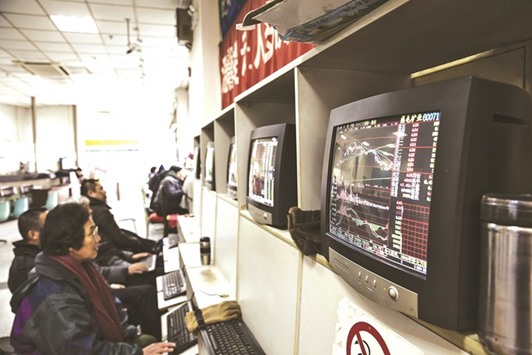
Traders work at a securities exchange house in Shanghai. As China’s sovereign bond yields tumble to decade-lows, investors are piling into the most defensive part of the stock market in search of returns.