


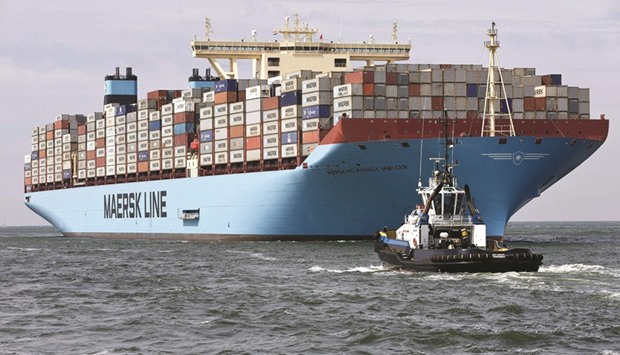
Danish oil and shipping conglomerate AP Moller-Maersk yesterday reported a plunge in profits in the second quarter in the face of tough market conditions, but beat expectations as it continued to cut costs. Net profit in the period plummeted to $101mn (€90.5mn) from $1.07bn as revenue fell 16% to $8.86bn.
“In response to challenging supply-demand imbalances, the group continues to execute on factors that are within our control by reducing cost and delivering high operational performance,” the company said in a statement.
“Maersk Oil has reduced operational costs by 25%, upholding a break-even at $40 to $45 per barrel.
The costs in Maersk Line have been reduced to an all-time low level,” it added. While chief executive Soren Skou said the results were “unsatisfactory”, earnings before interest and tax reached $656mn, higher than a Bloomberg analyst consensus of $551mn.
Shipping unit Maersk Line continued to suffer from overcapacity in the industry, posting an underlying loss of $139mn, down from $499mn a year ago as average freight rates were 24% lower.
Maersk Oil, which made an underlying profit of $130mn, said it had reduced its headcount by 25% since the third quarter of 2014.
The result “reflects that Maersk operates in historically difficult markets, where there is pressure on all parts of the business,” Sydbank analyst Morten Imsgard told Danish news agency Ritzau.
Amaya
Amaya, owner of websites PokerStars and Full Tilt, said Chief Executive David Baazov, who was charged with insider trading by Quebec’s securities regulator, stepped down on Thursday.
Amaya, which reported a higher-than-expected quarterly profit as it added more customers, said it was continuing to review its strategic options.
The company said it was in talks with “a number of parties” and some of these talks have progressed.
Amaya said it had cut expenses in its London, Sydney and Dublin offices, and expects some job cuts this year.
The company said on Friday interim CEO Rafi Ashkenazi replaces Baazov. Montreal-based Amaya said in March, soon after Baazov was charged, that he was taking an indefinite paid leave of absence.
The regulator brought charges against Baazov about two months after Amaya said it had received a non-binding proposal from him to take the company private.
A special committee of directors at Amaya will continue to “work with respect to the investigation of allegations” made by the regulator, the company said.
Amaya’s net earnings from continuing operations rose to $22.49mn, or 12 cents per share, in the second quarter ended June 30, from $6.38mn, or 3 cents per share, a year earlier.
Amaya’s total revenue increased by 10.2% to $285.9mn, as it added nearly 2mn customers in the quarter.
Revenue also beat analysts’ average estimate of $272.9mn.
JC Penney
JC Penney Co’s quarterly loss more than halved as the company cut costs and benefited from higher sales of home goods and footwear as well as beauty products at Sephora outlets in its stores. The department store operator also reaffirmed its full-year forecast of a 3-4% growth in comparable store sales, putting the company on track to achieve its first full-year adjusted profit in five years. Penney joined Macy’s Inc and Kohl’s Corp in reporting better-than-anticipated results, although expectations were low for all three. Penney was the only one which managed to increase comparable sales in the quarter. Department stores have been facing intense competition from online retailers such as Amazon.com and off-price chains such as TJX Cos’ TJ Maxx.
Shoppers are also spending more on big-ticket items such as electronics and cars than on clothes, a critical category for department stores.
Highlighting the challenges facing department stores, data yesterday showed that sales at clothing stores fell 0.5% in July, while online retail sales rose 1.3%. Apparel is the biggest-selling category online.
Talanx
German insurer Talanx dampened expectations yesterday that its full-year net profit would rise above its guidance after second-quarter earnings missed estimates, sending its shares sharply lower.
Germany’s third biggest insurance group is targeting around €750mn ($836mn) in net profit this year, and Chief Executive Herbert Haas said analysts should take its forecast seriously.
“Estimates that are substantially above that would be hard to reach,” Haas said.
Analysts polled by Reuters before the second quarter results had pencilled in a full-year net profit of €800mn, on average, with the lowest forecast at €773mn, still well above the official goal.
Talanx earned net profit of €734mn last year. Quarterly net profit tripled to €179mn but was below the lowest forecast of €195mn in a Reuters poll.
The poll average was €204mn. Both operating profit and income from investments fell short of analysts’ expectations in the second quarter. Haas warned that Talanx no longer had a lot of extra leeway in its notional budget for large claims in the remainder of the year, after damage from wildfires in Canada, earthquakes in Ecuador and storms in Germany pushed payouts to €495mn in the first half from €363mn in the same period last year.
German insurers including market leader Allianz were hit particularly hard by storms and floods in Germany in May and June that cost the sector an estimated €1.2bn.
Toshiba
Toshiba said yesterday it swung to a profit in the April-June quarter, thanks to cost cuts and the sale of its home appliance business.
The vast conglomerate, which is trying to turn the page on an embarrassing accounting scandal, said it booked a net profit of ¥79.8bn ($780mn) in the quarter, reversing a ¥12.3bn net loss a year ago. Toshiba also kept its fiscal year to March forecasts unchanged, with the group expecting a ¥100bn net profit on sales of ¥5.1tn.
A once proud pillar of corporate Japan, Toshiba has been besieged by problems, most notably a profit-padding scandal in which bosses for years systematically pushed subordinates to cover up weak financial results.
Japan’s national pension fund is among the disgruntled investors suing Toshiba, which saw its stock lose 40% of its value in the wake of the scandal.
The affair sparked the resignation of its president and a string of other top executives last year. Best known for televisions and electronics, Toshiba’s vast business was dented by the 2008 global financial crisis, while the 2011 Fukushima disaster squashed demand for atomic power at home in a big blow to the firm’s key nuclear division.
Golden Agri-Resources
Singapore-listed palm oil company Golden Agri-Resources said yesterday that its second-quarter operating performance had been hit by reduced output due to the El Nino weather pattern.
The world’s second largest palm plantation company’s earnings before interest, taxes, depreciation and amortisation fell 41% in the second quarter from a year before to $86mn. Palm product output in the second quarter fell 37% to 455,000 tonnes.
But the company’s net profit for the second quarter rose to $40mn, compared with $10mn a year ago, thanks to deferred tax income.
The latest results included net tax-related benefits of $104mn from a revaluation of its plantation assets in Indonesia.
The world’s second largest palm oil plantation company expects to see tax benefits in the same range in the second half.
While production is expected to improve in the second half of the year versus the first, the company will see its 2016 palm oil output falling 15-20% versus the previous year, Richard Fung, director of investor relations, said on a conference call.
He expects crude palm oil prices to stay range bound for the rest of the year.
Petrobras
Oil company Petrobras reported second-quarter profit that fell by nearly a third from a year earlier, missing analysts’ expectations as oil prices fell and it took charges for layoffs and the impairment of a refinery.
Petroleo Brasileiro, as the company is formally known, said net income fell 30% to 370mn reais ($118mn) in the three months ended June 30 compared with a profit of 531mn reais a year earlier, the company said in a statement.
Last year’s profit was one of the most anaemic quarterly results in the company’s recent history.
The second-quarter 2016 profit comes after a 1.25bn reais loss in the first quarter of this year.
The average profit estimate of eight analysts surveyed by Reuters was 1.81bn reais.
Estimates, though, ranged from a 5.56bn real profit to a 1.25bn real loss, as analysts struggled again with a lack of clear Petrobras guidance. Part of the problem for analysts trying to chart the company’s progress is Petrobras’ huge debt, Chief Financial Officer Ivan Monteiro told reporters on Thursday.
This requires the company to make quick changes to preserve enough cash to pay its obligations.
While total debt has eased 2% since the end of 2015, at $124bn it is still the largest in the oil industry.
“From our point of view the company is becoming more predictable,” Monteiro said.”Clearly we’re still facing difficulty because the company’s debt level is still very high...still at a level where we are required to maintain a very high level of liquidity.”
MAERSK