


External Affairs Minister Sushma Swaraj yesterday informed Rajya Sabha that 55,730 Indians have returned from Saudi Arabia since August 2015 and the government was closely monitoring the situation in Gulf countries.
She also said government was taking all possible steps to ensure welfare and protection of the Indian community in these countries.
According to the minister, multilingual helplines have been set up in India and in Gulf countries.
The Indian Worker Resource Centre (IWRC) has also been set up in Dubai that provides toll-free helpline and walk-in counselling facilities, she added.
“Four more IWRCs have been approved in Sharjah, UAE, Riyadh and Jeddah in the Kingdom of Saudi Arabia and Kuala Lumpur in Malaysia,” said Sushma Swaraj.
“There is around 8mn strong resident Indian community in the Gulf countries. An estimated 70% of them are blue collar workers.
Indian missions in Gulf countries receive various types of complaints from Indian workers including non-payment/delayed payment of wages, sudden closure of companies, ill treatment, excessive working hours, filing false charges with police authorities, withholding of passports, dishonouring terms of the contract and exit visa,” she added.
“Those employed in oil and gas and construction sectors are among the most vulnerable where downsizing and lay-offs have been reported. There are some reports of Indian workers being asked to leave before completion of their existing contracts,” said Sushma Swaraj.
She also pointed out that instances of unpaid salaries for last few months and non-availability of food in some labour camps of two big companies in Saudi Arabia have also been reported by Indian workers.
“The government is closely monitoring the situation and is taking all possible steps to ensure the welfare and protection of the Indian community. Our missions and posts have been pro-active in liaising with the host countries in resolving difficulties faced by Indian workers,” she added.
The strength of the Indian community in Saudi Arabia is relatively stable.
As per statistics available with the Indian mission, the size of the Indian community, which was 2.75mn in December 2014 increased to 2.96mn in November 2015 and further to 3.05mn in February 2016, said the minister.
“The responsibility of resettlement of the returnees primarily rests with the state governments. The (federal) government stands ready to extend necessary cooperation to states in this regard,” said Sushma Swaraj.
India also officially appreciated Saudi Arabia’s prompt action to provide relief to Indian workers who were retrenched by a Saudi company.
“We appreciate the magnanimous view taken by the Saudi Arabian government of granting exit visas expeditiously and agreeing to bear the expenses for the travel of the workers,” External Affairs Ministry spokesperson Vikas Swarup said in his weekly media briefing here.
“The swift action to tackle a localised problem specific only to some companies of Saudi Arabia signifies the deep and abiding relationship that our two countries share,” he said.
Following reports of retrenchment of the workers by the Saudi Oger company, Minister of State for External Affairs V K Singh visited Saudi Arabia last week.
According to Swarup, Singh “had very productive meetings” with the Saudi Minister for Labour and Social Development Mufrel al-Haqbani and other senior dignitaries.
“As a result of these meetings, the process of lodging claims and making arrangements for those Indian workers wishing to come back to India or relocate to another company has already started,” the spokesperson said.
The crisis also saw Saudi King Salman issuing a series of directives to address their problems, and earmarking 100mn Saudi riyals ($26mn) to address the concerns of the workers and end their suffering.
King Salman also directed the Saudi passport department to facilitate exit visas and other procedures for the distressed workers.
Swarup said in his media briefing that the first batch of 26 Indian workers left Jeddah for New Delhi on Thursday by a Saudi Arabian Airlines flight.
“Once they arrive, respective state governments will be making arrangements for their travel to their home towns,” he added.
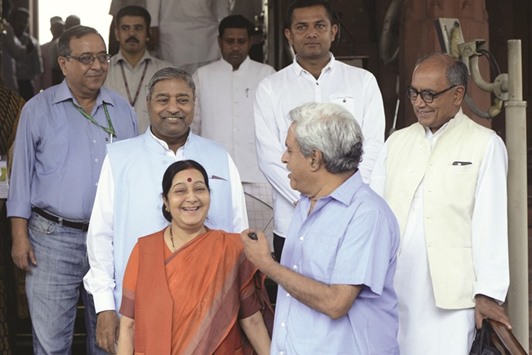
External Affairs Minister Sushma Swaraj arrives at Parliament in New Delhi.