


On the back of his assured debut record 1987, Jordanian-Pakistani rocker Naser Mestarihi delves deeper into the gritty, British rock sound in his new album Praed Street, and the results are impressive.
While most old schoolers loathe modern rock for its apparently synthetic feel and fluffy form, artistes such as Mestarihi turn back the clock on rock music in its “glory days”, channelling the same spunk, speed and fury without sounding dated.
Top quality production values sure have played a big part in achieving an edgy sound on this record, but ultimately it’s Mestarihi’s singular faith in the timelessness of ’70s and ’80s rock that glues old school style with a contemporary vibe and sounds right and relevant for 2016.
Best known as being the first rock musician to officially release a rock album out of Qatar – the Naser Mestarihi EP – the singer-songwriter flaunts progress in his composition game. Praed Street features YouTube drumming sensation Cobus Potgieter, whose fantastic drumming is a snug fit for Mestarihi’s racy guitars and clean vocals.
Preceded by a brief overture, Wicked Harlot opens the record with sufficient firepower. Driven by a melodic riff, the track builds its groove as it goes along. A blazing solo and some neat guitar harmonies stand out in this crunchy, crispy rock treat.
Fingerpicked guitars pull off a pleasant surprise in Enslaved. Mestarihi’s acoustic arpeggios work rather well for the melody that exudes somewhat of a bittersweet air. Moreover, his vocals get to stretch themselves out a bit here without being neutralised in distortion. The lyrics, too, are spot on.
Animal takes us back to the realm of unrelenting hard rock frenzy but it’s the following tracks that stir up a mean storm. Fire kicks off with a cool drum intro a la Megadeth’s Addicted to Chaos, and then keeps things interesting with a solid riff, ’80s rock-style chorus, and a nicely etched-out solo.
Up next is Winterburn serving us the brand of flaming hard rock that instantly sinks to the bone. Complex riffs that warrant elaborate five-finger crawls across the fret board are clearly a signature trait of Mestarihi’s music, and they return here, again, without abandoning melody. The chorus is laden with hard-to-ignore hooks. This one’s easily a potential crowd favourite.
Acoustic goodness returns only to make way for some vintage rock rhythms in Back to the Bay. As for Heart of Stone, it isn’t as exciting as the rest; the verses not really keeping up with the guitar play.
Birmingham Kiss more than makes up for the brief lull with its chunky power chords and robust riffs as drums take a backseat to good effect. This one’s a complete track with a neat acoustic section that effortlessly clambers its way back into heavier territories. Also, look out for a brief hat-tip to For Whom the Bell Tolls by Metallica.
Mestarihi gives his all in Prevail, the closing track and also the most epic in scale and heft. The heavy riffs shoulder the grand anthem feel without succumbing to the usual tropes of such ambitious compositions. The chorus especially is a winner. And that makes at least five tracks – Enslaved, Fire, Winterburn, Birmingham Kiss, and Prevail – worth repeat listens.
One might wonder why the album is titled Praed Street. The title is actually an ode to a Central London street in Paddington where Mestarihi wrote the majority of the new record over the course of four months at his apartment there. And the focus is writ large on Mestarihi’s record that tells us that the man has a plan and likes to stick to it.
In an interview with Community in April, Mestarihi had said that he makes music and performs live not for money, but for exposure, so that he can “eventually travel the world, visit different countries, play to different audiences and share with lots of people what I want to say with my music.”
Praed Street tells us that not only does Mestarihi have a lot to say, but also that it’s rather nice to listen to.
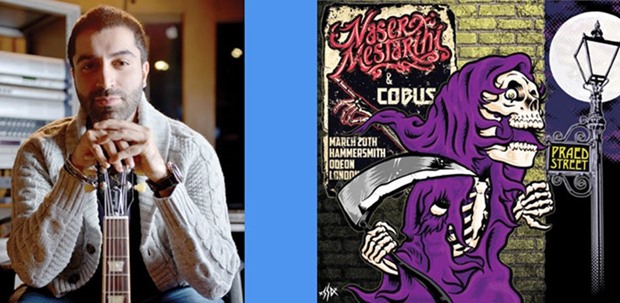
CLASSIC APPEAL: Naser Mestarihi turns back the clock on rock music in its u201cglory daysu201d, channelling the same spunk, speed and fury without sounding dated. Right: The cover of Praed Street.