


‘Property in Turbulent Times: Opportunities in London’, a seminar held by the Arab Bankers Association under the sponsorship of Qatari Diar, Al Rayan Bank and the National Bank of Kuwait drew a big turnout in the capital last week. The event was held at the Arab British Chamber of Commerce and post-Brexit impacts were high on the agenda.
The keynote speakers from Qatari Diar, Al Rayan, National Bank of Kuwait, Knight Frank and Trowers and Hamlins examined the prime London residential market, the changing tax landscape for UK property investing, and conventional and Islamic property finance.
Maisam Fazal, Head of Commercial Finance, Al Rayan Bank said he was seeing positive sentiment from GCC investors:
“Many of our Knightsbridge branch’s GCC based customers are visiting London post Eid. They are favourably inclined to invest in London real estate and are currently finding an extremely beneficial exchange rate — effectively giving them 12% more sterling for their money. Add to that the fact that some property funds in the last two weeks have announced that they must sell their commercial portfolio to return investments to shareholders, and it’s clear why some of our customers are becoming more active.”
Miles Wood, sales director, Qatari Diar, highlighted some of its prestigious developments in much sought after prime London locations. Southbank Place on the south bank of the River Thames near the London Eye, a mixed-use 5.25 acre site comprising 134,700sqm of net sales area including office, residential, retail and leisure uses is due for completion in 2108/18. Over 80% of phase 1 is sold.
Chelsea Barracks, Belgravia, comprising apartments, penthouses and townhouses set within 12.8 acres of traditional garden squares, has enjoyed a successful launch.
“Arguably, this was the most successful super prime scheme launched last year with 31 exchanges achieved,” Wood observed.
Liam Bailey, global head of research, Knight Frank, spoke about future supply.
“The real growth in supply is in places where you expect it to be — in East London and South of the river — places such as Tower Hamlets, Canary Wharf and Nine Elms,” he said. He added: “The market is relatively self-regulating. If you look at the numbers for housing starts in Greater London — there was a big uptick on new starts on site in 2015 but things have cooled off since then quite rapidly.
“The experience we have of talking to developers over the past year and a half is that they are reacting to recent circumstances and they will in many cases delay recent schemes.”
Speaking about the cabinet reshuffle post-Brexit and the departure of Chancellor of the Exchequer, George Osborne, he commented: “We have been surprised year on year by George Osborne’s activism in the tax arena — it will be interesting to see the reaction of the Treasury to the weaker six months’ trading in the property market and how that changes the thinking around future tax changes.”
On the subject of taxation, Andrew Sneddon, Partner, Trowers and Hamlins, cautioned investors to make sure they are fully up to date with recent and upcoming changes to the regulations.
“It is more and more important to understand the boundaries of the tax laws, so that you know how a transaction will be taxed and understand the consequences at each stage — i.e. on purchase, during the course of ownership, and sale.
“The use of a company to own residential property which will be used for the ultimate owner’s occupation (or is generally being left empty) is often no longer desirable from a tax perspective and many Gulf investors have restructured their property holdings or changed the way in which new acquisitions are structured,” he said.
James Roberts, chief economist, Knight Frank, painted a negative picture of retail. “Retail is the laggard over the last few years. There is too much retail stock in the UK. When a shopping centre becomes obsolete it doesn’t get demolished.”
Michael Bowles, Senior Real Estate Advisor, National Bank of Kuwait, said commercial property, particularly offices in Central London, even discounting the post-Brexit weaker picture in rents, remained an attractive income producing investment.
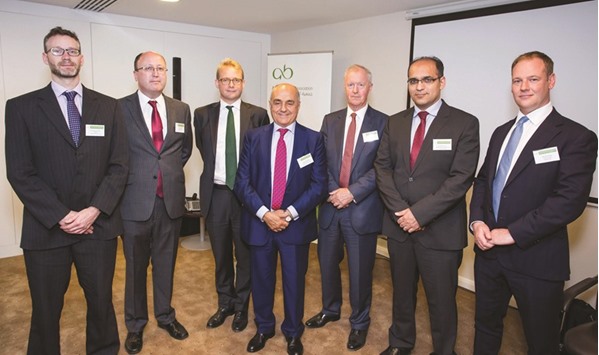
George Kanaan, CEO, Arab Bankers Association (centre), with keynote speakers at the seminar.