


The International Olympic Committee said yesterday it will study “legal options” before deciding whether to ban Russia from the Rio Games over its state-run doping programme.
But Russia’s Sports Minister Vitaly Mutko was barred from attending the Games and the IOC ordered a disciplinary commission to look into his ministry’s role in what a report called a “state-dictated failsafe system” if drug cheating.
The IOC executive held emergency talks yesterday on a bombshell inquiry commissioned by the World Anti Doping Agency (WADA) into the state doping at the Sochi Winter Olympics and other major events in Russia.
The IOC said it would not give backing to any international events in Russia because of the scandal but had to put back a decision on whether to bar Russia from the Rio Games which start August 5.
WADA has called for Russia to be banned from international competition. And IOC president Thomas Bach called the doping scandal a “shocking and unprecedented attack on the integrity of sport and on the Olympic Games.”
But the IOC said it “will explore the legal options with regard to a collective ban of all Russian athletes for the Olympic Games 2016 versus the right to individual justice.”
The Olympic leadership said it will also have to wait for a Court of Arbitration for Sports decision ruling Thursday on an appeal by 68 Russian athletes against an IAAF ban from competition.
Lead investigator Richard McLaren said Monday he had conclusive evidence that the four year doping scheme was directed by the sports ministry with the FSB intelligence agency.
The IOC said it will not grant any Rio accreditation “to any official of the Russian Ministry of Sport or any person implicated in the (McLaren) report.”
That includes Mutko, who has denied that the government directed the doping programme.
Mutko has already suspended five top deputies, including his number two Yury Nagornykh, described as the point man for running the cheating scheme.
The IOC is now racing against the clock to reach a final position on the status of Russian athletes in Rio.
WADA, the German Olympic committee and anti-doping bodies across the globe have backed calls for Russia’s outright ban from Rio.
That would be the first time a country has been banned from an Olympic Games over doping.
But the Association of Summer Olympic Federations and other groups have urged caution, pointing to the ethical issues of punishing athletes who have never failed drug tests.
The International Association of Athletics Federations has already barred Russian track and field contenders from Rio after a inquiry into widespread state-sponsored doping in the sport.
The CAS will rule Thursday on whether the IAAF had grounds to impose a blanket ban on a national federation, since such a suspension inevitably punished athletes with no positive drug test on their record.
IOC executives also ordered a re-analysis of all samples by Russian athletes taken at the 2014 Winter Olympics, vowing punishment against anyone who helped competitors cheat.
Because the Sochi Games are so tainted, the IOC said it would not give backing to any international sports events in Russia.
It called on “all International Olympic Winter Sports Federations to freeze their preparations for major events in Russia.”
This includes world championships and World Cups, the IOC said, calling or winter federations “to actively look for alternative organisers.”
McLaren said his team uncovered forensic evidence that proved Rodchenkov’s claims that Moscow set up a “failsafe” cheating system following the country’s poor performance at the 2010 Winter Games in Vancouver.
Main points from the emergency meeting
*The IOC has not ruled out a complete ban on Russia at the Rio Games, saying it will explore the legal options for imposing it versus the right to individual justice.
*The IOC will not organise or give patronage to any sports event in Russia, including the planned 2019 European Games.
*The Executive Board is “greatly concerned” by deficiencies in the fight against doping uncovered by the McLaren report. It calls on the World Anti-Doping Agency to convene an extraordinary conference on doping in 2017
*Russian athletes implicated in doping at the 2014 Winter Olympics in Sochi should be referred by WADA to international federations and the IOC.
*No member of the Russian Ministry for Sport implicated in the report will be accredited for the Rio Olympics.
*The IOC will begin a full enquiry into all Russian athletes at the 2014 Sochi Olympics, including forensic analysis.
*All Olympics winter sports federations have been told to halt preparations for any international events in Russia.
*International sports federations are advised to seek sanctions against Russia in cases where the WADA code is breached.
*The Executive Board reiterates its reversal of the “presumption of innocence” of Russian athletes, leaving their fate in the hands of international federations.
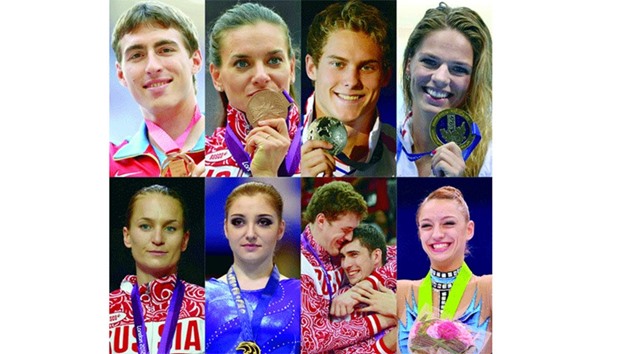
This combination of pictures created yesterday shows some of the top Russian athletes that may miss the upcoming 2016 summer Olympics in Rio de Janeiro. The International Olympic Committee (IOC) said yesterday it will study u201clegal optionsu201d on banning all Russian athletes from the Rio Games and also ordered a disciplinary commission to look into the role of Russian officials in a state-run doping system. Top from left: Sergey Shubenkov (men’s 110 metres hurdles), Yelena Isinbayeva (women’s pole vault), Vladimir Morozov (men’s 50-metre freestyle swim), and Yuliya Efimova (women’s 100m breaststroke swim). Second row, from left: Sofya Velikaya (Women’s sabre), Aliya Mustafina (Artistic Gymnastics), Dmitriy Muserskiy (L) and Dmitriy Ilinykh (men’s volleyball), and Evgenia Kanaeva (Rhythmic Gymnastics).