


 |
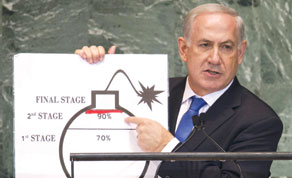
| Netanyahu uses a diagram of a bomb to describe Iran’s nuclear programme at the UN General Assembly on Thursday |
Israel’s media yesterday splashed their front pages with pictures of Prime Minister Benjamin Netanyahu literally drawing a red line for Iran on a bomb diagram at the UN General Assembly.
But while some commentators took jabs at the cartoonish visual aid, they said Netanyahu had scored a major PR coup, winning global headlines while setting a deadline that could help ease tense relations with the White House.
In a piece entitled “Bibi Boom,” Nahum Barnea of the Yediot Aharonot newspaper said Netanyahu “went back to basics, to the comic book drawings of his childhood”.
“He did well, because despite all the mocking of various individuals of little faith, the images of the Israeli prime minister and the bomb will be broadcast in every new edition around the world,” Barnea wrote.
Yossi Verter in the left-leaning Haaretz daily referred to the visual aid as “a cute drawing of a bomb with a fuse, that looked like it was copied from an American comic book or from a Walt Disney cartoon”.
But he pointed out that the simplistic presentation would resonate with “people who don’t have the patience for long words or in-depth discussions of centrifuges and enriched uranium and detonators”.
“He did what he does best: He took a complex, amorphous topic and made it simpler, more tangible, more easily absorbed and understood.”
Ofer Shelah, writing in the Maariv daily, acknowledged the stunt “succeeded in taking the cameras by storm”.
“But one does not eliminate an Iranian nuclear threat by gimmicks and speeches,” he warned.
“One does so by joint efforts, in intimate consultations with the administration in Washington and the US president... whom Netanyahu would like so badly to see in November shedding tears and conceding defeat.”
Israeli opposition leaders emphasised the need for Netanyahu to repair ties with Washington over Iran. But commentator Ben Caspit, writing in the Maariv newspaper, praised Netanyahu, saying he had laid out his case forcefully, but without damaging fragile US ties.
“He broadcast his message, he explained the issue, he provided an academic-scientific speech... he even used a cute graphic for illustration,” Caspit wrote.
“And he managed to do all this without furthering the crisis with the US and without raising the flames on the so-very sensitive relationship with the American administration.”