


 |
|
|
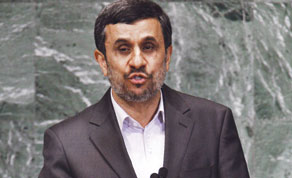
Iranian President Mahmoud Ahmadinejad yesterday disregarded a UN warning to avoid incendiary rhetoric and declared ahead of the annual General Assembly session that Israel has no roots in the Middle East and would be “eliminated”.
In remarks to reporters in New York, he also said he does not take seriously the threat that Israel could launch a military strike against Iran’s nuclear facilities, denied sending arms into Syria, and called economic conditions in his sanctions-hit country “not as bad as they are portrayed”.
Israeli Prime Minister Benjamin Netanyahu has hinted Israel could strike Iran’s nuclear sites.
“Fundamentally we do not take seriously the threats of the Zionists. ... We have all the defensive means at our disposal and we are ready to defend ourselves,” Ahmadinejad said.
He is in New York to attend the UN General Assembly. His speech is scheduled for tomorrow.
On Sunday, UN Secretary General Ban Ki-moon met with Ahmadinejad and warned him of the dangers of incendiary rhetoric in the Middle East. He did not heed the warning.
Ahmadinejad alluded to his previous rejection of Israel’s right to exist. “Iran has been around for the last seven, 10 thousand years. They (the Israelis) have been occupying those territories for the last 60 to 70 years, with the support and force of the Westerners. They have no roots there in history,” he said, speaking to reporters through an interpreter.
“We do believe that they have found themselves at a dead end and they are seeking new adventures in order to escape this dead end. Iran will not be damaged with foreign bombs,” Ahmadinejad said, referring to Israel.
“We don’t even count them as any part of any equation for Iran. During a historical phase, they represent minimal disturbances that come into the picture and are then eliminated,” Ahmadinejad added.
In 2005, Ahmadinejad called Israel a “tumour” and echoed the words of the former Iranian supreme leader, Ayatollah Khomeini, by saying that Israel should be wiped off the map.
Ahmadinejad said the nuclear issue was one ultimately between the US and Iran, and must be resolved with negotiations.
He added, “The nuclear issue is not a problem. But the approach of the US on Iran is important. We are ready for dialogue, for a fundamental resolution of the problems, but under conditions that are based on fairness and mutual respect.”
“We are not expecting a 33-year-old problem between the US and Iran to be resolved in a speedy fashion. But there is no other way besides dialogue,” Ahmadinejad said.
Ahmadinejad also addressed a high-level meeting on the rule of law at the UN yesterday, saying states should not yield to international law as imposed “by bullying countries”.
In the past, Ahmadinejad has used his UN speeches to defend Iran’s nuclear programme and to attack Israel, the US and Europe. He has questioned the Holocaust and cast doubt on whether 19 hijackers were really responsible for the September 11 attacks on the US in 2001.
Western envoys typically walk out of Ahmadinejad’s speeches in protest.
Ahmadinejad said yesterday that Iran - under UN, US and European Union sanctions over its nuclear programme - is used to economic restrictions and is not severely affected by them.
“The conditions in Iran are not as bad as they are portrayed by some,” he said, adding that his country can survive without oil revenues.
Ahmadinejad added that Iran’s economy is in much better shape that that of the EU, which he said was “on the verge of disintegration and collapse”.
The UN and Western officials have accused Iran of supplying weapons to Syria’s pro-government forces. Ahmadinejad rejected the charge. “The so-called news that you alluded to has been denied vehemently, officially,” Ahmadinejad said in a response to a question. “We seek peace in Syria. We like and love both sides. ... We see both sides as equally our brothers.”
“In Syria, the intervention and meddling from outside have made conditions that much tougher,” Ahmadinejad said. “We must help to quell the violence and help ... (facilitate) a national dialogue.”
A UN Security Council panel of independent experts that monitors sanctions against Iran has uncovered several examples of Iran transferring arms to Syria. The US and Britain say they are providing non-lethal assistance to Syria’s rebels such as communications equipment, but not arms.
Ahmadinejad also addressed the issue of a California-made anti-Islam video, The Innocence of Muslims, that has sparked anti-American protests around the Muslim world. He appeared to reject Washington’s position that while it condemns the video’s content, freedom of expression must be upheld.
“Freedoms must not interfere with the freedoms of others,” Ahmadinejad said. “If someone insults, what would you do? ... Is insulting other people not a form of crime?”
Since the controversy over the video erupted this month, some Muslim leaders have reiterated calls for a UN measure outlawing insults to Islam and blasphemy in general.
Ahmadinejad also was asked about a move by an Iranian religious foundation, in response to the video, to increase its reward for the killing of British author Salman Rushdie.
“Where is he now?” Ahmadinejad asked of Rushdie. “Is he in the US? If he is, you shouldn’t broadcast that for his own safety.”