


Prime Minister Narendra Modi yesterday followed in Mahatma Gandhi’s footsteps in South Africa, where the Father of the Nation forged his famed policy of non-violent civil disobedience.
Modi is on the second leg of a five-day African trip which began in Mozambique and will also take him to Tanzania and Kenya - an itinerary designed to underline India’s growing engagement with the continent.
After talks with President Jacob Zuma in Pretoria on Friday, Modi travelled to the eastern province of KwaZulu-Natal, home to most of South Africa’s 1.3mn people of Indian origin - the largest diaspora population in Africa.
Modi took a short, symbolic train ride to the provincial capital, Pietermaritzburg, where Gandhi was ejected at the station in 1893 after refusing to leave the first class compartment because of his race.
Then a 24-year-old lawyer who had recently arrived in South Africa, Gandhi spent the night in the station and the insult was seen as formative in his fight against racial oppression during two decades in South Africa and later in British-ruled India.
“It was in South Africa that Mahatma Gandhi conceptualised his politics,” Modi told a thousands-strong diaspora gathering at a stadium in Johannesburg on Friday evening.
“This is the birthplace of Satyagraha (the policy of non-violent struggle).”
After the train trip, Modi travelled to the coastal city of Durban, the heart of the Indian community, where he visited the Phoenix settlement founded by Gandhi in 1904 as a community based on self-reliance.
“From Pietermaritzburg to Phoenix. PM visits the farm where Gandhiji spent formative years of his political work,” external affairs ministry spokesman Swarup tweeted.
Modi was guided around the place by Gandhi’s granddaughter Ela Gandhi.
During his visit, Modi inaugurated an exhibition and also signed the visitor’s book after lighting a lamp.
To mark his visit to the settlement, he planted the sapling of a pepper and bark tree.
The prime minister also visited Sarvodaya, which served as Gandhi’s residence till his return to India in 1914.
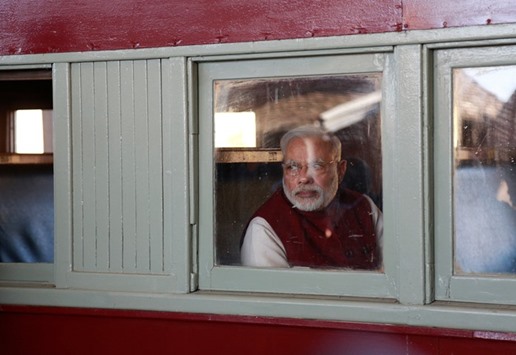
Prime Minister Narendra Modi arrives by train at the railway station in Pietermaritzburg yesterday.