


A government overhaul of the British Steel Pension Scheme – crucial to convincing anyone to buy Tata’s British assets – is in jeopardy after Britons’ vote to leave the European Union deepened the fund’s debts and depleted its assets, analysts and industry sources said.
Pension trustees said they were in talks to assess the impact of last week’s decision, which sources said already raised the risk Tata Steel’s giant Port Talbot plant would be closed, destroying thousands of jobs.
Britain’s government has been trying to overhaul the British Steel Pension Scheme (BSPS), one of the nation’s largest defined benefit plans, with 130,000 members.
Even before last week’s referendum, its £14bn ($18.79bn) of liabilities exceeded its assets by roughly £700mn.
Tata Steel inherited the pension scheme when it bought Corus, formerly British Steel, for $12bn in 2007.
“The trustee and its advisers are working with stakeholders to understand what, if any, impact the outcome of last week’s referendum might have on the discussions regarding the future of the scheme,” the trustees said in a statement. Hymans Robertson, which advises firms that sponsor schemes such as BSPS, estimated British pension liabilities had gone up by about 5 % — or several hundred million pounds in the case of the steel pension fund – since close of business on Thursday, because of the falls on stock markets and predicted fall in interest rates triggered by the British referendum.
A spokesman for Tata said he couldn’t comment on the latest funding for the BSPS, but like all pension funds, asset values moved up and down.
The FTSE rose around 2% yesterday, partly recovering from heavy losses.
At least three of the seven bidders are still interested in buying Tata’s British operations, industrial sources said, but they have also said Tata might decide to shut its loss-making Port Talbot plant in Wales and focus resources on its more successful Dutch plant at IJmuiden. On Tuesday, Dutch union leaders said Tata was investing between €200mn ($221.7mn) and €300mn in IJmuiden.
Tata Steel has not disclosed financial details. In an emailed statement, it said the Dutch spending was part of its long-term strategy drawn up several years ago to invest in equipment to supply, especially to car manufacturers, higher-strength steels with improved surface quality. “This significant investment will further improve IJmuiden’s competitive position as a manufacturer of world-class products for our most demanding customers,” it said.
Tata Steel says it has invested £1.5mn in Britain and a similar amount in the Netherlands since 2007.
But the climate for investment in Britain is now stormy, analysts say, and steel pension liabilities are the least of the government’s worries.
“The Port Talbot operation has never been further from viability. Due to current uncertainty, private investment in Port Talbot is unlikely,” Ben Orhan, senior economist at IHS Global Insight Pricing and Purchasing, said.
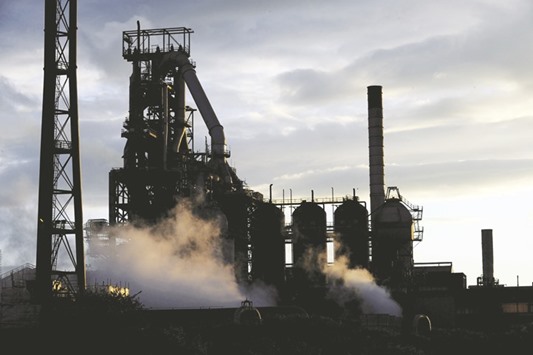
One of the blast furnaces of the Tata Steel is seen at sunset in Port Talbot, South Wales. The Indian firm says it has invested u00a31.5mn in Britain and a similar amount in the Netherlands since 2007.