


Matt Cullen took a needle in a fractured toe before each of the Penguins’ final 11 playoff games.
Bryan Rust’s right hand was so banged up that he couldn’t use it for congratulatory handshakes.
Sometime in the next few days, word likely will surface that en route to winning the Stanley Cup, the Penguins had someone who competed despite a broken arm. Or a herniated disk. Or multiple organ failure.
Hey, it was the playoffs.
Everybody’s hurt, and nobody complains. “You have guys playing through an awful lot,” Cullen said. Of course, any team that endures the grind of a two-month playoff run is going to deal with injuries.
Probably a lot, and more than a few of them serious.
That’s why it was important that all 19 Penguins defensemen and forwards who dressed for more than two playoff games chipped in at least three points. Everyone contributed.
The Penguins didn’t have anyone finish in the top three in the playoff scoring race _ Logan Couture, Brent Burns and Joe Pavelski of San Jose occupied those spots _ but did have 11 different guys account for their 16 game-winning goals. “It was pretty amazing, how everybody seemed to have a big piece of the pie,” Cullen said. “Everybody, at a different point, stepped up and made a difference.”
And it wasn’t all about goals and assists. Everyone who made three or more appearances blocked shots – Phil Kessel was credited with four – and even the most finesse-oriented guy threw an occasional check.
It was all part of the identity forged after Mike Sullivan replaced Mike Johnston as coach in mid-December.
Sullivan, who had been with the Penguins’ minor league team in Wilkes-Barre, didn’t just bring a fresh face or a new voice to the mix. He came with a well-defined style of play that he began to install within hours of arriving at Consol Energy Center.
“Mike came in and made it pretty clear how he wanted us to play, what he expected from each individual guy,” centre Sidney Crosby said. “I think guys just welcomed the opportunity, welcomed the challenge, tried to get back on track.”
Crosby conceded that it “took some time... didn’t happen overnight,” but Sullivan said the players immediately accepted his teachings, which stressed skating and committing to stingy team defense.
“In order to win championships, you got to keep it out of your net. Everybody has to buy in to that idea for us to get to where we want to go. To their credit, they did, down to a man.”
Sharks coach Pete DeBoer acknowledged as much after Game 6. “It’s not just their speed,” he said. “They have good sticks, too.
“They force you into quicker decisions. They really challenge your execution.”
General manager Jim Rutherford did his part by acquiring defenseman Trevor Daley and left winger Carl Hagelin, both of whom made the Penguins faster and enhanced their balance.
“When we started to get some traction towards the end of the season, we won a lot of games down the stretch, I think they really started to believe,” Sullivan said.
“That was the hard evidence that, ‘Hey, if we play a certain way, we can be a good team and beat anybody in this league.’”
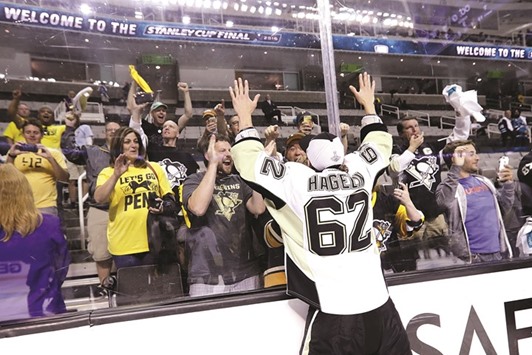
File picture of Carl Hagelin of the Pittsburgh Penguins celebrating with fans after defeating San Jose sharks to win the Stanley Cup.