


Indian stocks capped their steepest three-day drop in six weeks and volatility climbed as growing anxiety over the outcome of the “Brexit” vote sapped demand for riskier assets and investors awaited monthly inflation data. ICICI Bank and State Bank of India, the nation’s top lenders, were among the biggest losers on the S&P BSE Sensex.
Tata Motors, the owner of Jaguar Land Rover, posted the largest drop in a month. Bharat Heavy Electricals, India’s biggest power-equipment maker, retreated the most in two weeks. Tata Steel slid for a second day.
The Sensex lost 0.9% to 26,396.77 at the close in Mumbai, bringing its three-day decline to 2.3%, as the rupee weakened the most in three weeks. The MSCI Asia Pacific Index sank 2% as a poll showing a 10 percentage-point lead for Britain to exit the European Union sent jitters through regional markets.
The Federal Reserve also meets to decide on policy this week while economists predict India’s consumer-price gains probably accelerated to a four-month high in May. “This uncertainty in the markets is around the Fed and the Brexit,” R K Gupta, managing director of Taurus Asset Management Co, which oversees $590mn, said from New Delhi. “The Fed may not raise rates, but the commentary would be keenly looked into. The market was already in an overbought position, a selloff was overdue.”
The Sensex’s 10-day historical volatility index, a gauge of price swings, has rebounded from a seven-month low reached last week.
India’s benchmark index completed a weekly decline on Friday, ending two weeks of advances, as investors turned cautious before events including central bank meetings in the US and Japan that could roil markets.
The gauge has risen 15% from a low reached in February. The Sensex last week climbed to its highest level since October 28 and its 14-day relative strength index rose to 71, breaching a level some investors see as a signal that further gains may be capped.
The gauge had fallen every day since then. Economists predict a vote for so-called Brexit will send the pound to the lowest level in more than three decades, while a victory for the ‘Remain’ camp would drive the currency toward the highest this year.
The Fed is seen leaving interest rates unchanged tomorrow though investors will scrutinise its post-meeting statement for signals on the timing of the next increase in US borrowing costs. Most economists expect the Bank of Japan to expand record monetary stimulus in July rather than on June 16, a Bloomberg survey shows.
Foreign investors bought $32.8mn more Indian shares than they sold on June 10, the smallest inflow in four days, data compiled by Bloomberg show.
That’s the 13th straight day of buying, taking net purchases since April 1 to $1.6bn. ICICI Bank plunged 3.5%, the most since May 2.
State Bank of India lost 2%, while Axis Bank fell 1.8%. Tata Motors tumbled 2.8%, the most since May 10. Bharat Heavy Electricals retreated 2.8%, extending this year’s loss to 29%. Tata Steel declined 3.4%.
Meanwhile the rupee posted its biggest decline in more than three weeks on concern foreign funds will cut equity holdings after losses in local stocks deepened.
The rupee weakened for a third day, retreating 0.6% to 67.14 a dollar in Mumbai, according to prices from local banks compiled by Bloomberg. That’s the biggest drop since May 19 and took its loss in 2016 to 1.5%, Asia’s worst performance.
The currency may decline to as low as 67.80 in the coming months, according to Edelweiss Financial Services.
“Investors are nervous ahead of big events such as the Federal Reserve meeting and the UK referendum,” said Ankur Jhaveri, co-head of currency and rates at Edelweiss Financial Services in Mumbai. “That’s driving them toward safe-haven assets. We see the rupee depreciating more given the global uncertainties.”
Foreign investors bought $32.8mn more Indian shares than they sold on Friday, the smallest inflow in four days, data compiled by Bloomberg show. They have poured a net $2.81bn into local equities in 2016.
Recent polls indicating the UK’s June 23 referendum on EU membership is too close to call is spurring fear in global investors already on the edge given the monetary-policy reviews in the US and Japan.
Indian sovereign bonds dropped ahead of the inflation data. The yield on notes due January 2026 climbed three basis points to 7.53%, its highest close since March 16, according to prices from the central bank’s trading system. That’s the biggest advance since April 21.
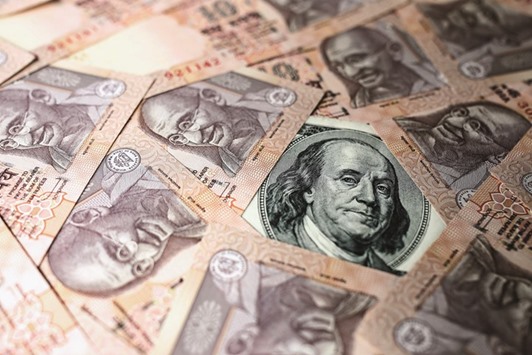
A US dollar bill and Indian rupee banknotes are arranged for a photograph in Mumbai. The rupee yesterday posted its biggest decline in more than three weeks on concern foreign funds will cut equity holdings after losses in local stocks deepened.