


The troops joined up at mid-day on a patch of cracked earth where Mali and Niger meet. Nothing marked the spot, beyond a few shrubs and acacia trees offering scant shade to their military pickups.
Deep in the semi-desert, no fence or customs post delineates a frontier that means nothing to jihadists hiding in the vast area, and yet hinders states trying to co-ordinate a counter-attack on the regional arm of Al Qaeda with the help of France.
“We are precisely on the line that marks the border,” Eric, a French army captain, said as his ‘Barkhane’ detachment was joined by soldiers from Niger and Mali.
“The aim is to control this transit zone for the population and (against)... armed groups,” said the officer, who under guidelines of the French forces and their West African allies gave only his first name.
After the meeting, the 40 French troops crossed from Niger into Mali to continue the operation codenamed Siham, which aims to flush out al Qaeda. But the local forces remained on their own sides of the frontier, bound by the limits of cross-border co-operation.
The 800km (500 mile) border between the former French colonies of Niger and Mali, which runs from the semi-arid Sahel region north into the Sahara desert, is largely unpoliced.
With few natural obstacles or visible frontiers, it is an ideal base for Al Qaeda in the Islamic Maghreb (AQIM) and its splinter group Al Morabitoun to launch attacks across West Africa. Control of the Sahel is therefore crucial.
As well as kidnapping dozens of Westerners and attacking military units, they have shaken the region with a string of attacks on “soft” targets in Mali, Burkina Faso and Ivory Coast, including on two hotels used by foreigners.
On top of this, to the north Libya is in a security vacuum while to the south, Nigerian-based Boko Haram militants are fighting to establish an Islamic state.
France and Belgium have both suffered communications failures that allowed Islamist militants to slip across their borders and stage attacks since late last year.
So what hope is there for some of the world’s poorest nations, such as Niger and Mali which alone cover an expanse two thirds of the size of western Europe?
Attempting to answer this question, West African states are making a push for better co-ordination which may be slowly producing results.
Chad was quick to mobilise 2,000 troops in Niger to prepare a counterattack against Boko Haram, on a request from Nigerien President Mahamadou Issoufou, after the group seized a Nigerien town last Saturday.
Similarly, in the Siham operation around 1,300 Malian and Nigerien troops staged a sweep between blinding sandstorms for two weeks starting at the end of May. They collected intelligence, tracked down jihadist cells and probed suspected training camps, although there was no fighting with the militants.
“Thanks to co-operation, we are managing to control this area that has been uncontrolled for a long time,” Hamani, a Nigerien captain, said as his 80 troops secured the area near the border rendezvous. “But we need a much bigger presence on the ground.”
Three days before the meeting, Malian troops scoured the desert on their side, stopping at an encampment by the frontier.
At one point, Malian and French troops surrounded several terracotta houses, watched by residents sitting quietly outside, but there was no sign of militants.
“It was a nomad camp,” a Malian Lieutenant called Mohamed said after the forces had searched the whole village. “We are reassured, they are reassured. Mission accomplished,” he said.
The Sahara and Sahel were long the preserve of nomadic peoples, such as the Touareg, who in centuries past built great Islamic empires on trade connecting Africa’s interior with its Mediterranean coast. Today, the camel often remains the main form of transport.
Now the militants, though driven out of urban centres in northern Mali by French troops in 2013, are using the same desert routes to launch their attacks.
“If we want to avoid seeing the enemy operating in a country, taking refuge in a second and stocking up in a third one, borders have to be controlled,” a French military officer at Operation Barkhane’s headquarters in N’Djamena, said.
Since 2014, Chad, Niger, Mauritania, Mali and Burkina Faso have carried out a number of co-ordinated operations on either side of their borders, with the help of about 3,500 French troops still in the region.
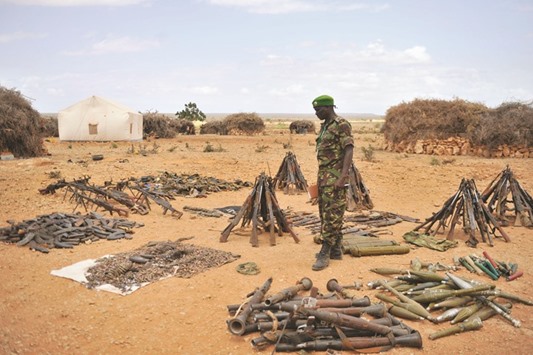
A handout photo taken yesterday and released by AMISOM shows Lt Col Joe Kibet, the Spokesperson of the AMISOM, examining weapons captured from Al Shebaab militants in Halgan village of Hiran region.