


On the occasion of India’s Prime Minister Narendra Modi’s visit to Qatar at the invitation of HH the Emir, Sheikh Tamim bin Hamad al-Thani, it gives me immense pleasure to highlight the dynamics of the bilateral relations between the GCC and India.
The Indian PM’s visit has resulted in the signing of a number of MoUs between Qatar and India to boost co-operation between the countries. It includes an MoU in which Qatar will invest in India’s National Investment and Infrastructure Fund (NIIF); another one between the Finance Intelligence Unit-India (FIU-IND) and the Qatar Financial Information Unit (QFIU) which facilitates exchange of intelligence related to money laundering, terrorism-financing and related crimes and persons connected thereto; one between India’s Ministry of Skill Development and Entrepreneurship and Qatar’s National Qualifications Authority/Supreme Educational Council which seeks cooperation in skills development and mutual recognition of qualifications, an MoU on tourism which aims at bilateral cooperation in the field of planning and developing of tourism; an MoU seeking cooperation in areas of occupational and environmental health, pharmaceuticals and medical education; the First Executive Programme for MoU in the field of Youth and Sports; and an agreement which seeks cooperation and mutual assistance on matters pertaining to customs administration through exchange of information and intelligence. They will also enhance cooperation in the field of cyber security, including prevention of the use of cyberspace in support of terrorism and extremism.
Indian economy has grown by 7.6% in 2016. In November 2015, the Indian government eased regulations for 15 sectors including mining, defence, construction, real estate, civil aviation, and broadcasting and single-brand retail for FDI investments.
A World Bank report in September 2015 ranked India at 130 among 189 countries in the ease of doing business, up 12 places from 142nd rank in previous year.
India has a record FDI $40bn during in the financial year ended March 2016. Qatar can look forward to participating in India’s investments through the FDI route.
The bilateral trade between Qatar and India during 2014-15 is close to $16bn. Qatar is the largest supplier of LNG to India. India has a long-term contract with Qatar to buy 7.5mn tonnes of LNG a year. In December 2015, RasGas Company and Petronet LNG Limited have entered into a binding sale and purchase agreement (SPA) for the supply of an additional one million tonnes per annum (mta) of LNG to India starting in 2016.
In March 2015, MoUs were signed between Qatar and India in the field of Information and Communication Technology and Scientific and Technical cooperation in the field of Radio and Television; and an agreement for Mutual Cooperation and Exchange of News.
In 2013 Qatar Foundation Endowment agreed to invest $1.26bn in Indian telecommunications company Bharti Airtel with a 5% stake. Indian infrastructure companies can participate in Qatar’s FIFA World Cup projects.
A glimpse of the overall trade between GCC and India in 2014-15 reveals that it was over $133bn. Saudi Arabia-India trade is above $39bn and Saudi was the fourth largest trading partner for India in 2014-15.
In April 2016, a Framework for Investment Promotion Cooperation between Invest India and the Saudi Arabian General Investment Authority was agreed to improve investment flows between both the countries. In May 2015 India and Saudi Arabia committed to increase cooperation in fields of trade, IT, communication and higher education. Renewable energy is also an area which offers tremendous scope for Indian and Saudi companies to work together.
The trade between India and the United Arab Emirates during 2014-15 was close to $59 billion. The UAE is the third largest trading partner for India in 2014-15. The UAE and India plan to create a $75bn fund to invest in Indian infrastructure. The fund will support the expansion of India’s network of railways, ports, roads, airports and industrial corridors.
The countries also aim to increase bilateral trade by 60% in the next five years. In February 2016, an MoU was signed which deals with facilitating investments by the UAE funds in India’s infrastructure projects and aims at achieving further economic, trade and investment cooperation.
A General Framework Agreement was also signed between the UAE’s Ministry of Foreign Affairs and India’s Ministry of New and Renewable Energy, which sets out cooperation in the area of renewable energy, especially in the area of investments and joint research and development efforts between the two countries.
The bilateral trade between Kuwait and India during 2014-15 was close to $15bn. Kuwaiti investments in India during 2014-15 were in excess of $2.5bn.
Trade between Bahrain and India during 2014-15 was close to $0.9bn. In February 2014, India and Bahrain signed three agreements in the fields of economic engagement and sports. Bilateral trade between India and Oman during 2014-15 was above $4bn. In May 2016, India and Oman signed four MoUs on defence cooperation.
• Dr R Seetharaman is Group CEO of Doha Bank.
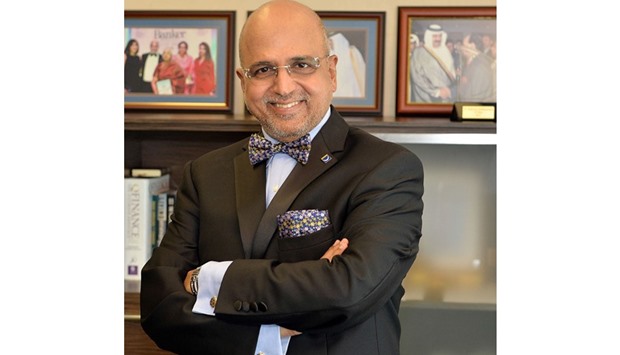
Dr R Seetharaman