


 |
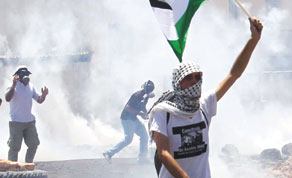
| A protester waves the Palestinian national flag as others seek cover from teargas during clashes after a weekly protest against the Jewish settlement of Qadomem, near Nablus in the West Bank yesterday.According to medical sources, 23 Palestinians were injured in the clashes |
The head of the Islamist group Hamas in the Gaza Strip said yesterday he was confident Egypt’s new president would shield the Palestinian enclave from Israeli attack and fully open its borders to end a trade blockade.
Mohamed Mursi, who won power in last month’s presidential election in Egypt, is a member of the Muslim Brotherhood and ideologically close to Hamas.
The Gazan Islamists long complained that his predecessor Hosni Mubarak, ousted from power last year in a popular revolt, sided not just with Israel, but also with their political rival - Palestinian President Mahmoud Abbas’s Fatah movement.
So far, Hamas has seen little sign of a policy shift since Mursi took office and diplomats said the Egyptian leader had so many domestic problems that he could ill-afford to dedicate much time to retooling Cairo’s relations with the Palestinians.
However, Ismail Haniya, the head of Hamas’s Gaza government, told worshippers in a mosque that change was coming.
“We are confident that Egypt, the revolution led by Mursi, will never provide cover for any new aggression or war on Gaza,” he said. “We are confident that Egypt, the revolution led by Mursi, will not take any part in blocking Gaza,” he added.
Israel launched a military offensive against Gaza in late 2008 in an effort to end repeated rocket attacks from Hamas, which refuses to recognise Israel’s right to exist. Some 1,400 Palestinians and 13 Israelis died in the three-week war.
Low-level violence continues and Israel still imposes a rigid trade blockade on Gaza, arguing that it is needed to prevent weapons or arms-making materials into the enclave.
Politicians in Israel have expressed alarm in private over the election of Mursi and fear that their country’s peace treaty with Egypt could be eroded over time.
Mubarak helped police the Gaza blockade and did not let any goods officially cross the border, saying this was part of long-standing accords with Washington and Israel. However, Cairo always turned a blind eye to a thriving black market business with Gaza conducted through a warren of underground tunnels.
A few hundred people cross in and out of Gaza every day via Egypt and the number of passengers has increased since Mursi took office. However, officials on both sides attribute this to the start of the holiday season rather than to any policy shift.
Mursi’s position will soon be put to the test when he meets officials from Hamas and the secular Fatah, which is backed by Western powers and rules in the West Bank.
Protocol means that Mursi will almost certainly see Abbas first, with one source saying it would happen on Wednesday. No date has yet been set for a Hamas delegation to be received.
Both Abbas and Hamas are likely to be pressed by Egypt to end their long-standing hostilities, which at one point saw the two sides fight a brief civil war in Gaza.
“No one can help the Palestinians more than they can help themselves. They should take daring steps to end their rifts,” an official in Cairo said by phone.