


 |
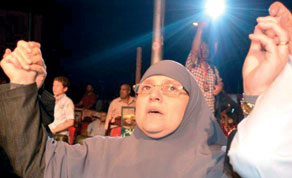
| Naglaa Ali Mahmoud |
Mahmoud, a mother of five, has gone public with this refusal in the very few interviews she has given since her Islamist husband, Mohamed Mursi, began his bid for presidency some months ago.
She is the opposite of her two fashion-conscious predecessors, Suzanne Mubarak and Jihan al-Sadat, who were born to British mothers.
Mahmoud looks like millions of other Egyptian women living in working-class areas. She wears a long veil that covers her body down to the waist, with mostly plain colours, and no make-up.
Unlike her predecessors who held master’s degrees, Mahmoud, 50, has not been to university. She married her cousin, Mursi, in 1979 after she finished high school at the age of 17.
She travelled with him in the early 1980s to the US where he studied for a doctorate in engineering. Two of their five children - four boys and a girl - were born in the US and have US passports.
In the US, she worked as an Arabic-English translator for Muslim Americans. It was then that she and her husband officially joined the Muslim Brotherhood, Egypt’s oldest and most organised Islamist group.
Mahmoud, who has three grandchildren, prefers to be called Umm Ahmed, or the mother of Ahmed - her eldest son - as is the tradition among Egypt’s middle and lower classes.
In a recent interview with the local magazine Nus Al Dunia, she described Mursi, 60, as a responsible man and an understanding husband who helps her with household chores, including cooking.
During campaigning, Mursi did not speak much about his wife, though he praised her for playing “the biggest role” in his life.
Her role was mostly to support her family’s political activities in the Brotherhood. Her husband and two of their children - Ahmed and Usama - were detained several times under Hosni Mubarak’s 30-year rule, when the Muslim Brotherhood was banned.
She recalled that when security agents raided their house to detain Ahmed, she told him to consider his jailing a “political detention, something that would make him proud”.
Mahmoud says she will not get engaged in politics like former first ladies. Instead, she plans to continue community work, which she has been doing for years, like helping young girls in the Brotherhood.
Shortly after her husband was declared winner in Egypt’s presidential elections last week, Mahmoud visited families of protesters killed in the popular revolt that ousted Mubarak last year.
“Islam has taught us that the ruler is the people’s servant, which means that his wife is also the servant of the people. Any other title imposed on us must not be an entry in the dictionary of my political and social life,” she said.