


Reuters/London

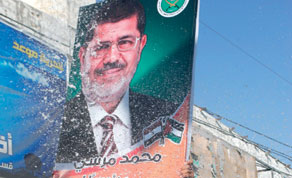
Palestinians celebrate in Gaza City yesterday after Muslim Brotherhood candidate Mohamed Mursi was declared president of Egypt
Islamists around the world hailed Mohamed Mursi’s election as Egypt’s first freely chosen president as a victory for their cause yesterday while the West and Israel reacted with caution, wary of his political agenda.
The Muslim Brotherhood’s candidate’s win over former army general Ahmed Shafiq was widely seen as an historic event with far-reaching consequences beyond Egypt’s borders.
“The Egyptian nation did not elect a president just for Egypt, but for the Arab and Islamic nations too,” said Fawzi Barhoum, a spokesman for Hamas in Gaza.
Viewing the victory through the prism of the Arab Spring uprisings that toppled leaders in Tunisia, Libya, and Yemen as well as Egypt, Islamists said they saw Mursi’s win as proof their “revolution” was on the march.
The US, which provides vast military aid to Egypt, welcomed the result but made it clear it expected Mursi to ensure stability and not to veer to extremes.
“We believe that it is important for President-elect Mursi to take steps at this historic time to advance national unity by reaching out to all parties and constituencies in consultations about the formation of a new government,” White House spokesman Jay Carney said in a statement, calling on the new leader to ensure Egypt remains “a pillar of regional peace”.
Iran, which prides itself on its own Islamist credentials, paid fulsome tribute to those it called “the martyrs of the (Egyptian) revolution”, whom it said were responsible for ushering in “a splendid vision of democracy.”
“The revolutionary movement of the Egyptian people... is in its final phases of a new era of developments in the Middle East and the Islamic Awakening,” the foreign ministry said.
In Britain, William Hague, the foreign minister, also gave a muted welcome to Mursi’s victory.
“It will be important for the new government to stand for national unity and reconciliation, to build bridges across Egyptian society and to uphold human rights, including the rights of women and religious minorities, and the rule of law,” Hague said in a statement.
France issued a similar statement. “It is key today that the transition, which started in February 2011, continues so that a democratic and pluralist political system establishes itself in Egypt, guaranteeing civil liberties and political freedom to all citizens,” the office of President Francois Hollande said.
Israel voiced respect for Mursi’s victory and the “democratic process”, but called on the new administration in Cairo to maintain the peace accord maintained by Egypt’s ousted leader Hosni Mubarak for 33 years.
In the United Arab Emirates, the Wam news agency said the government respected “the choice of the Egyptian people in the context of its democratic march”.
Bahrain’s state news agency said King Hamad congratulated Mursi, praising “an atmosphere of freedom and democracy”.
In Iraq, Ali al-Moussawi, an aide to Prime Minister Nuri al-Maliki, said the government welcomed the win as “a major step in the right direction to boost democracy in Egypt”.
A senior Western diplomat in Cairo made it clear the West was trying to put a brave face on Mursi’s win and was keen to stress the nature of the election that brought him to power.
“Egypt has a civilian, democratically elected president for the first time in its history,” the diplomat said.
“An imperfect presidency is way better than none at all,” he said, urging the Brotherhood not to provoke the army, which has curbed presidential powers, into limiting them any more.
Many Egyptians living abroad expressed relief, saying they felt their homeland finally had a chance to flourish.
In Riyadh, Abdulhamid Saraya, 60, an expatriate Egyptian engineer, said Mursi’s win was a watershed.
“I am happy we are ending 30 years of injustice. (Ahmed) Shafiq’s loss is an end to a dark age that forced us to leave the country and live abroad most of our lives to escape injustice and poor living conditions,” he told Reuters.
Muslims elsewhere said they were also pleased with the result, but some had advice for the new president.
In Algeria, Atef Kedadra, a senior journalist on the country’s El Khabar daily newspaper said Mursi’s victory carried tremendous symbolic importance but he would now have to show he was inclusive. “If he appoints only Islamists, he will lose because the Islamists are not used to ruling a country.”
In Abu Dhabi, a 37-year-old government employee who gave his name as Seif was upbeat. “I am sure Egypt has a bright future. The Brothers are forced to keep up with modernity, progress and openness. They don’t want to destroy or harm their country.”
Catherine al-Talli, a prominent Syrian human rights lawyer, said events in Egypt were likely to encourage the opposition battling President Bashar al-Assad.
“It shows that the popular will brings about democratic change, and that when the people chose to rise against repression they can defeat it,” she said.
In Jeddah, Saudi Arabia, Laya, a woman who goes to Cairo frequently, said she was concerned about how Mursi’s victory would change the way women were treated.
“They will think it’s now okay to approach girls and reprimand them for the way they dress,” she said.