


 |
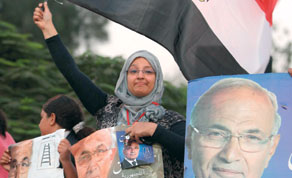
| A supporter of Ahmed Shafiq holds his portrait during a demonstration in Cairo yesterday |
Egypt’s election commission delayed the announcement of presidential results scheduled for today, as tension spiked over who will succeed ailing ousted president Hosni Mubarak after moves by the ruling military to extend powers.
“Egypt’s election commission, headed by judge Faruq Sultan... has decided to delay the announcement of the presidential election run-off,” the official Mena news agency said late yesterday, without giving a new date.
The run-off on June 16 and 17 pitted Muslim Brotherhood candidate Mohamed Mursi against Mubarak’s last prime minister Ahmed Shafiq, with both candidates claiming victory.
The election commission said it was looking into appeals from lawyers of both candidates over alleged campaign violations and disputed vote counting.
The commission said it would “continue examining the appeals... which will require more time before the final results are announced”.
The announcement came amid uncertainty over the health of Mubarak, following a flurry of reports about his condition.
Mubarak “is not clinically dead”, a medical source said. “He is in a coma and the doctors are trying to revive him.”
“He has been placed on an artificial respirator,” the source added, in an account confirmed by a member of Egypt’s ruling military council, who spoke on condition of anonymity.
Egypt’s state television carried a ticker item saying Mubarak was in “a coma and is not clinically dead”.
State news agency Mena had earlier said the ousted strongman, 84, had been declared clinically dead after suffering a stroke in prison and being transferred to hospital.
“Hosni Mubarak is clinically dead,” the report said. “Medical sources told Mena his heart had stopped beating and did not respond to defibrillation.”
News of Mubarak’s failing condition came amid a backdrop of legal and political chaos.
The Brotherhood appeared set on a confrontation path with the ruling Supreme Council of the Armed Forces (SCAF) which issued a new constitutional declaration granting itself sweeping powers.
The state-owned daily Al Ahram summed up the mood saying Egypt was facing “the most critical 48 hours in its history”.
Early Monday the Brotherhood said their candidate had won the run-off, and on Tuesday provided what they said were certified copies of ballot tallies to bolster their claims.
But Mursi’s rival Shafiq also claimed a victory, with his campaign accusing the Brotherhood of issuing false figures.
A group of independent judges—headed by the ex-head of the Judges Union, Zakaria Abdel Aziz—who monitored the voting process confirmed in a news conference that Mursi had won, according to their tally.
The new president, irrespective of the result, will not wield the near-absolute authority Mubarak enjoyed for three decades, after SCAF issued a constitutional declaration on Sunday claiming sweeping powers.
Mubarak’s successor will also inherit a struggling economy, increased insecurity and the challenge of uniting a nation divided by the uprising and its deadly aftermath.
Should Mursi win, it will be a real test for the Brotherhood’s ability to deal with problems on the ground.
The new dynamics will mean that “SCAF will command the national security of Egypt and leave domestic issues to the president. Any problems and the blame will be shifted to the elected representative,” said Joshua Stacher, a political analyst and Egypt expert at Kent State University.