


 |
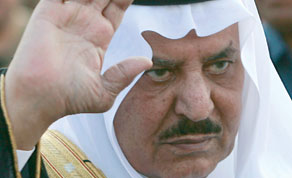
| Nayef bin Abdulaziz al-Saud |
Saudi Arabia’s Crown Prince Nayef bin Abdulaziz al-Saud has died just eight months after becoming heir to 89-year-old King Abdullah, the royal court said yesterday.
“With deep sorrow and grief... King Abdullah mourns his brother... Crown Prince Nayef who passed to the mercy of God on Saturday outside the kingdom,” said a royal court statement carried by state media.
A source close to the royal family said Nayef had died suddenly in Geneva after receiving treatment for a knee complaint. He was thought to be 78.
Nayef, interior minister since 1975, was appointed crown prince in October after the death of his elder brother and the previous heir Crown Prince Sultan.
State television said the burial would be in Makkah today.
The king of Bahrain ordered a three-day mourning period, Bahrain News Agency said.
In a statement, British Foreign Secretary William Hague expressed his government’s condolences, saying he was sad to hear of Nayef’s death.
“He served the Kingdom for many years with great dignity and dedication and his contribution to the prosperity and security of the Kingdom will be long remembered,” said Hague.
French President Francois Hollande said France had lost “a friend”.
“Saudi Arabia has lost a statesman who left his mark on the development of his country and contributed decisively to its security and the common fight against terrorism,” a statement from Hollande’s office said.
Nayef “also contributed in a decisive way to Franco-Saudi relations,” the statement added. “France loses a friend with whom it had formed a close relationship.”
Hollande offered his “heartfelt condolences” to Nayef’s family and the Saudi people.
Prince Nayef travelled abroad several times this year for medical reasons, including to Algeria, the US and Switzerland, where he was shown on television in Geneva three days ago greeting supporters.
Less than two weeks ago, his brother Prince Ahmed bin Abdulaziz was quoted as saying in a Saudi daily that the crown prince was in “good health” and would “soon” return to the kingdom.
On May 26, SPA reported that Prince Nayef had left the country for medical tests abroad for the second time in less than three months, without naming his destination.
In March, the royal palace said he was in Algeria on holiday after the results of medical tests carried out in the US city of Cleveland were reported as “reassuring.”
He returned to Saudi Arabia from Algeria on April 10.
Like his brothers King Abdullah and Defence Minister Prince Salman, he was one of the nearly 40 sons of Saudi Arabia’s founder, Abdulaziz bin Saud, who established the kingdom in 1935.
Prince Salman, his likely successor, was made defence minister in November and had served as Riyadh governor for five decades.
Born in the western city of Taif in 1933, Nayef was quickly pushed into public service, being named governor of Riyadh when he was barely 20.
His elder brother Fahd brought him into the interior ministry, where he was named deputy minister in 1970 and minister five years later, when Fahd became crown prince.
Nayef was credited for the successful crackdown on Al Qaeda militants in subsequent years, halting their wave of bloody attacks on the kingdom between 2003 and 2006.
His internal security campaign forced Al Qaeda leaders and many members to flee to Yemen, where they formed Al Qaeda in the Arabian Peninsula (AQAP).
Charged with managing the country’s borders, its internal crime-fighting apparatus and the internal intelligence force the mabahith, Nayef dismantled charities which used to collect donations for the late Osama bin Laden and his extremist network.
Nayef’s son Prince Mohamed, who is the assistant interior minister and the kingdom’s top counter-terrorism official, escaped assassination in 2009 when a suicide bomber from Yemen tried to kill him.
In recent years he transferred day-to-day security responsibilities to Mohamed, who has been even more methodical in pursuing Islamist radicals and battling their ideology.