


AFP/Tunis

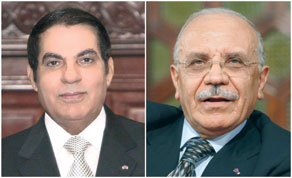
Ben Ali: life sentence and Kacem: 12-year jail term
A Tunisian court sentenced Zine al-Abidine Ben Ali to life yesterday for his role in the deaths of protesters during last year’s uprising which toppled the veteran dictator and inspired the Arab Spring revolutions.
Prosecutors had sought the death penalty for Ben Ali, who is exiled in Saudi Arabia, over the killing of 22 people while trying to douse the revolt in the two central cities of Thala and Kasserine.
The ruling came after a six-month trial at the military court in Kef, located about 170km west of Tunis.
Former interior minister Rafik Belhaj Kacem was also sentenced to 12 years in jail over the case.
The court dropped cases against eight officials, including former presidential guard chief Ali Seriati and the former director of riot police Moncef Laajimi, which drew angry shouts from victims’ families.
“The judge could not fully read the verdict because of the ruckus,” lawyer Abdelkarim Maghouri, who followed the trial, said.
But judge Chokri Mejri said: “We tried to hand down a fair verdict, and nobody put any pressure on us. We were only guided by God and our own personal conviction.”
Earlier yesterday, a Tunis military court sentenced Ben Ali in absentia to 20 years’ imprisonment on various charges including incitement to murder.
Ben Ali was found guilty of “inciting disorder, murder and looting”, the court said in its verdict over the deaths of four youths, shot dead in the town of Ouardanine in mid-January 2011.
The weeks of protests that started in December 2010 toppled one of the most entrenched autocratic regimes in the Arab world and led to democratic elections in October that saw a moderate Islamist party rise to power.
The strongman’s ouster toppled the first domino in the wave of protests which became known as the Arab Spring and is still sweeping the region.
Ben Ali faces countless trials and has already been sentenced to more than 66 years in prison on a range of other charges including drug trafficking and embezzlement.
Tunisia’s government yesterday blamed Salafists and old regime loyalists for the worst unrest since Ben Ali’s ouster but dismissed suggestions that Al Qaeda initiated the violence.
One man died and around 100 people were injured, including 65 policemen, as a result of a three-day wave of riots which appears to have been triggered by an art exhibition that included works deemed offensive to Islam.
The authorities arrested more than 160 people and slapped a curfew on several regions, including the greater Tunis area.
The overnight curfew was eased by two hours yesterday from 10 pm to 4am.
Salafists were blamed for destroying art work deemed “blasphemous” at the exhibition in northern Tunis on Sunday.
The incident sparked clashes across the country that saw police stations and political party offices torched.
A joint statement by the leaders of Tunisia’s government, constituent assembly and presidency condemned “extremist groups who threaten freedoms”, in a thinly-veiled reference to the Salafists.
The government is led by the moderate Islamist Ennahda (Renaissance) party while the presidency and post of parliament speaker are held by the two parties that came closest in the first post-revolution polls.
The unrest came after an audio message in which Al Qaeda supremo Ayman al-Zawahri called on Tunisians to rise up and demand the implementation of Islamic law hit the Internet on Sunday.
But Ennahda’s influential leader, Rached Ghannouchi, dismissed suggestions that the sudden nationwide Salafist mobilisation was a direct consequence.
“Ayman al-Zawahri has no influence in Tunisia. This man is a disaster for Islam and for Muslims,” he told reporters. “We see no link between the Salafists in Tunisia and Al Qaeda.”
In his message, Zawahri criticised Ennahda for failing to impose full Shariah: “It is astonishing to find a leadership claiming to belong to Islam saying that it does not want to rule with it.”