


 |
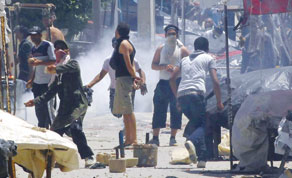
| Protesters hurl stones at security forces during clashes in Tunis yesterday |
Tunisian rioters detained after attacks blamed on Islamists will be charged under anti-terror legislation, the government said yesterday as it declared a nighttime curfew.
“The people arrested will be brought to justice under the anti-terror law decreed in 2003,” a ministry official told reporters the day after a wave of unrest that left 100 injured including 65 policemen, and led to 165 arrests.
The Salafists denied involvement in the rampage in several areas of the capital Tunis and in the country’s northwest, and instead called a protest after this week’s Friday prayers.
The unrest continued yesterday, and authorities declared a dusk-to-dawn curfew in eight regions, including the greater Tunis region, of the country that sparked the Arab Spring revolts.
Police fired teargas to quell attacks allegedly by Salafists and others who torched and pillaged a local court in western Tunis and attacked several police stations in the north, ministry spokesman Khaled Tarrouche said.
In particular, rioters tried to force their way into an art gallery in the northern Tunis suburb of La Marsa, where several paintings deemed “blasphemous” had been slashed overnight Sunday. Seven officers were slightly injured.
Justice Minister Nourredine Bhiri condemned the “terrorist act” and pledged that the guilty would “pay a heavy price”.
“These are terrorist groups which have lost control, they are isolated in society,” Bhiri told radio Shems FM.
Yesterday saw attacks on the headquarters of a fine arts institute in eastern Sousse and that of a centrist opposition party in southern Tatatouine, the TAP news agency reported.
Later in the afternoon, Salafists gathered in Sousse’s central square to denounce the artworks at the La Marsa gallery.
National mufti Othmane Batikh said the works contained “symbolic representations that offend the sacred in Islam”.
Calling on Tunisia’s constituent assembly to pass legislation against blaspheming Islam, he added: “The sacred symbols of Islam are red lines that must not be crossed.”
The violence has fuelled fears among moderate Tunisians over the rise of radicalism since a revolution last year toppled the Zine al-Abidine Ben Ali regime and elections ushered in a moderate Islamist government—and whether that government will be able to stamp it out.
In what appeared to be a concession to the Salafists, the dominant Ennahda party announced that it would propose a constitutional provision against blasphemy.
“Religious symbols are above all derision, irony or violation,” said the party, which has 89 seats out of 217 in Tunisia’s post-revolution constituent assembly.
And later yesterday, Culture Minister Mehdi Mabrouk said he would lodge a complaint for blasphemy against the organisers of exhibition in La Marsa titled “Spring of the Arts”.