


 |
|
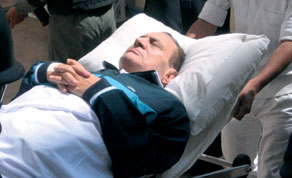
A file photo dated September 7, 2011 shows Hosni Mubarak on a stretcher while being taken to the courtroom during his trial in Cairo |
Egypt’s ousted president Hosni Mubarak, now serving a life sentence over protester killings, said the authorities “want to kill” him in jail as his health deteriorated, his lawyer told AFP yesterday.
“He says: ‘They want to kill me. Save me, Mr Farid, find me a solution,” said Farid al-Deeb, his chief lawyer in the murder and corruption trial which ended this month with his sentencing.
Mubarak’s health has deteriorated since his incarceration on June 2, and he was defibrillated twice to revive his heart yesterday, a prison hospital source said.
“His condition is very critical,” Deeb said. “I appeal through Agence France-Presse to all world leaders and NGOs: save Mubarak.”
An interior ministry source had said that Mubarak’s condition was “critical but stable”, as officials weighed transferring him to a military hospital in the capital.
The 84-year-old former strongman was sentenced to life behind bars for suppressing a revolt against his rule in early 2011 in which nearly 850 protesters were killed.
He is currently being held in an intensive care wing of Tora prison on the outskirts of Cairo.
Prison authorities agreed yesterday to allow his son Alaa, also jailed in the same prison on corruption charges, to join him and his other son Gamal.
Mubarak’s wife Suzanne and his two daughters-in-law were given special permission to visit him on Sunday following rumours that he had died in prison, state media reported.
His family has formally requested a transfer to a Cairo hospital, but such a move could unleash the anger of activists and protesters at a particularly sensitive time in the country.
Deeb said he had visited Mubarak on Saturday and found his medical wing under-equipped. “It is a scandal,” he said.
Elections for Mubarak’s successor are just days away, a highly polarised contest between the ousted president’s last prime minister Ahmed Shafiq and the Muslim Brotherhood’s candidate Mohamed Mursi.
Authorities have neither accepted nor declined the request to transfer Mubarak, saying only that he will be “treated like all prisoners”.
“Moving him now is very sensitive, with the threat of protests in Tahrir and the elections coming up,” a security official said, referring to Cairo’s iconic Tahrir Square, symbol of the 2011 uprising.
In Washington, State Department spokeswoman Victoria Nuland said the US did not have enough information on Mubarak to comment on his conditions.
“Frankly, we don’t have any independent information,” she told reporters.
Mubarak’s interior minister Habib al-Adly also received a life sentence in the same trial, but the court acquitted six police commanders.
Mubarak’s defence and lawyers filing suits on behalf of the uprising’s victims have both said his sentencing could be easily appealed after the police commanders’ acquittals.
The verdicts fuelled several days of protests around the country.
Since his ouster in February last year, there have been contradictory reports about Mubarak’s health, with some saying he was suffering from cancer, heart ailments or depression.
Mubarak attended hearings in the trial that started in August last year on a medical stretcher, after being airlifted from his detention on Cairo’s outskirts.