


 |
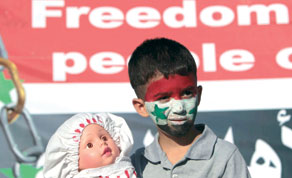
| An Israeli Arab boy holds a doll during a demonstration against Syrian President Bashar al-Assad in the northern Israeli village of Tamra yesterday |
Army shelling and gunfire killed at least 29 civilians in protest towns yesterday, a watchdog said, as Russia pushed its idea of an international conference including Iran to end the bloodshed in Syria.
Russian Foreign Minister Sergei Lavrov also stressed that Moscow would “not sanction the use of force at the UN Security Council”.
His proposal came as worldwide anger grows over the crackdown by Syrian President Bashar al-Assad’s regime on a revolt in which more than 13,500 people, mostly civilians, have been killed since March 2011.
Nine women and three children were among 17 people killed in a pre-dawn bombardment of a residential neighbourhood in the southern city of Daraa, the Syrian Observatory for Human Rights said.
Dozens more were wounded, some of them seriously, in the city which was the birthplace of the uprising against Assad’s rule, the Britain-based watchdog said.
In nearby Jordan, hundreds of Syrian refugees demonstrated in the border town of Ramtha to protest against the deaths in Daraa, Jordan’s official Petra news agency reported.
Meanwhile, UN observers who visited the village of Al Kubeir, where at least 55 people were killed earlier this week, said they saw blood on the walls and “a strong stench of burnt flesh”.
The Al Kubeir incident prompted Western governments to launch a push for tough new sanctions against Damascus. But Russia, along with China, has already vetoed two Security Council resolutions against Assad.
In central Syria, government forces yesterday pounded several rebel neighbourhoods of Homs city with artillery and mortar fire, killing six civilians, the Observatory said.
It said the army killed at least 29 civilians nationwide, while three soldiers died in clashes in the north and four rebel fighters were also reported killed, taking yesterday’s death toll to at least 36.
Observatory head Rami Abdel Rahman told AFP that dozens of regime troops were killed or wounded in fighting at Al Heffa in Latakia province, but was unable to give exact figures.
Diplomats in New York said Britain, France and the US would quickly draw up a Security Council resolution proposing sanctions against Syria following a grim report from the monitors on their visit to Al Kubeir.
“We will move fast to press for a resolution,” one UN diplomat said.
More than 20 unarmed UN observers were allowed into Al Kubeir on Friday, a day after monitors were shot at and prevented from entering the village.
“Inside some of the houses, blood was visible across the walls and floors. Fire was still burning outside houses and there was a strong stench of burnt flesh,” UN spokesman Martin Nesirky said in New York.
UN officials have made clear they believe government forces and their allies were behind the attack on the mainly Sunni Muslim village surrounded by an Alawite population loyal to Assad.
Damascus denied responsibility and blamed foreign-backed “terrorists”.
Russia yesterday pushed the idea of an international conference on the more than 15-month-old crisis in Syria, with the Arab state’s ally Iran also given a place at the table despite US opposition.
“We want this event to be effective,” Lavrov told reporters.
“To say that Iran doesn’t have a place because it is already to blame for everything and it’s part of the problem and not part of the solution, this is thoughtless to say the least from the point of view of serious diplomacy.”
Susan Rice, the US ambassador to the UN, has called Iran a “spoiler” and said it is “part of the problem in Syria”. Washington has accused Iran of arming Assad’s forces.
Russia has said a conference on Syria was needed to overcome differences over how the peace plan of UN-Arab League envoy Kofi Annan should be implemented.
Lavrov said permanent UN Security Council members Russia, the US, France, Britain and China, Syria’s neighbours including Lebanon and Jordan, as well as the European Union and Arab League should take part in the conference.
Moscow wants to hold the forum “as soon as possible”, Lavrov said, without elaborating.
He again reaffirmed Russian opposition to the use of force. “We will not sanction the use of force at the UN Security Council,” he said.
Lavrov added that Moscow would be “glad” to support Assad’s departure but only if Syrians themselves agreed on it.
In Turkey, leaders of the exiled Syrian National Council were meeting in Istanbul to pick a new leader after the resignation of Burhan Ghalioun.
He resigned on May 17 after activists accused him of ignoring the Local Co-ordination Committees, which spearhead anti-government protests on the ground, and of allowing the Muslim Brotherhood to play a leading role within the bloc.
Sources in the group said the aim was to pick a “consensus” candidate acceptable to Islamists, liberals and nationalists. Abdel Basset Sayda, a Kurd and member of the SNC’s executive, was tipped to take over.
The new leader will face the challenge of boosting the SNC’s credibility with activists and rebels inside Syria, as well as with the international community.