


 |
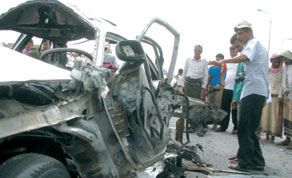
| A security agent and onlookers inspect a car damaged in a bomb attack in the southern Yemeni port city of Aden yesterday |
Tens of thousands of Yemeni civilians are trapped by fighting during a US-backed army offensive on Islamist militants in the south of the country and urgently need help, the International Committee of the Red Cross (ICRC) said yesterday.
The Yemeni army is trying to recapture towns in the southern province of Abyan that were seized by Al Qaeda-linked militants last year during a popular uprising against President Ali Abdullah Saleh, who formally stepped down in February.
In support of the army campaign, the US has stepped up drone strikes against suspected members of an Al Qaeda branch that is one of its main global security concerns.
“We are extremely concerned about the people trapped inside, and about the dire situation in Jaar, Shaqra and in nearby areas where fighting is going on,” Eric Marclay, the head of the ICRC delegation in Yemen, said in a statement.
“Our staff were there a few days ago to assess the situation and found serious, urgent needs that, if not met, could lead to the displacement of over 100,000 people. Thousands of people have already fled to safer places.”
Residents are facing food, power and water shortages, while and health-care services are inadequate, the ICRC said.
On Tuesday, all the roads to Abyan were blocked and movement in and out of the province was restricted, it added.
The Geneva-based ICRC urged all combatants to grant it immediate access and security guarantees.
Concerned about the humanitarian and security crisis in Yemen, Gulf Arab states and the West pledged more than $4bn in aid to the impoverished state last month, $3.25bn of which was pledged by Saudi Arabia alone.
About 40% of Yemenis live on less than $2 a day. Aid agencies said in May almost half of them lack enough to eat.
Yesterday, Finance Minister Sakhr al-Wajih said the World Bank has agreed to give Yemen $100mn “as a direct support for the budget”. His comments to state news agency Saba came after a meeting with the US Treasury’s assistant secretary for international affairs, Charles Collyns, in the capital Sanaa.
In April, Yemen’s parliament approved a 2012 budget with a deficit of 561bn rials ($2.6bn) and a sharp rise in spending to meet demands for more jobs and social services.
In southern Yemen, where the army is trying to dislodge Al Qaeda-associated militants holding large swathes of land since last year, at least seven suspected militants died when car bombs exploded prematurely, local officials said yesterday.
One security official said a suspected car bomb blew up before it reached an army checkpoint on a highway in Lahej province yesterday, killing three of its passengers.
To the east of Lahej, four insurgents were killed on Tuesday night while preparing a car bomb in the militant-held town of Shaqra, another security official said.
Militants also fired mortars yesterday at the headquarters of an army brigade in Kod, a town near the southern city of Zinjibar, killing two soldiers, including Colonel Nasser al-Qadi, and wounding 12 others, a military source said.
In north Yemen, tribal mediators have begun trying to end months of fighting between Shia Muslim rebels and rival Sunni Muslim Salafis near the Saudi border, a Salafi spokesman said.
The move comes one day after the Shia rebels, or Houthis, agreed to join a national dialogue aimed at resolving Yemen’s multiple political conflicts.