


 |
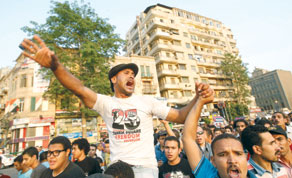
| Protesters shout slogans against presidential candidate Ahmed Shafiq during a demonstration in Cairo’s Tahrir Square yesterday |
The Islamist aiming to be Egypt’s president vowed to keep Hosni Mubarak in jail forever and forecast his liberal rivals would back him in an election runoff against a former general he sees as heir to the deposed leader.
In his first international media interview since he won the first round ballot, the Muslim Brotherhood’s Mohamed Mursi professed confidence the liberal rivals would swallow their fears of religious rule and vote him to victory.
Mursi appealed to last year’s revolutionaries by pledging, if elected, to keep Mubarak, the president they toppled, in jail - whatever verdict a court passes on him today. He said he would order a re-trial based on fresh evidence and an independent judicial process.
“It is not possible to release Mubarak,” Mursi told Reuters on Thursday as he - and the political movement that transformed him from unknown to frontrunner in a matter of a few weeks - works to win over disappointed liberals who now face an awkward choice between the Islamist and Mubarak’s last prime minister.
In the three days since results of last week’s first round confirmed that the 60-year-old, US-trained engineer would face Ahmed Shafiq, a former air force chief who still cites Mubarak as a role model, Mursi has yet to win the endorsement of any of the main losing candidates.
He offered a number of policies intended to appeal to the centre and stressed that he was now the only alternative to more military rule, whatever misgivings about the Brotherhood still troubled those who launched the protests against Mubarak.
“This nation and this people, who have revolted against Mubarak, will not accept his system again,” said Mursi, laying claim to a revolutionary mantle which the Brotherhood’s critics say is ill-deserved due to its hesitation in taking on Mubarak.
But Mursi cannot be assured of a win in a vote scheduled for June 16 and 17 after Shafiq, appointed by Mubarak in his final days in power, made a surprise surge into the run-off, winning over Egyptians desperate for a return of order after the 15 months of turmoil since Mubarak was ousted.
Seeking to broaden his appeal, Mursi has reached out to rivals who lost in the first round, saying he was opening up the vice president posts and even premiership to those outside his group. He has tried to woo wary liberals and Christians, saying in office he would not impose Islamic strictures on society.
With the decider looming, Mursi has the backing of Salafi Muslims, who control the second biggest parliamentary bloc. But he has yet to win the clear endorsement of any of the main centrist candidates squeezed out in the first round. And he may well need their support for victory.
“If they don’t support the candidate of the revolution and don’t support the march to stability and true freedom ... who will they support?” Mursi said in the interview at a hotel on the outskirts of Cairo.
“I am certain they will support the path of the revolution.”
Neither Mursi nor Shafiq won more than a quarter of votes cast last week, leaving a big section of the electorate which frets about putting a conservative Islamist in charge or handing power back to the military men who have run Egypt for 60 years.
With the country deeply polarised, Mursi has not only sought to present himself as the rightful inheritor of the anti-Mubarak revolt but he has dismissed Shafiq’s campaign claim that only he has the experience of office to deliver on promises.
“The old regime did not achieve anything for the Egyptian people. It was a failed system ... Nothing new will come of it only a continuation of oppression and suppression,” said Mursi, who pledged to quit the Brotherhood and its party if elected, so that he could be a head of state without partisan allegiance.
Many of Egypt’s liberals, and the big Christian religious minority, are sceptical about the Brotherhood’s promises after it reneged on a pledge not to seek the presidency. Some accuse the movement of being heady with its success in a parliamentary election and now bent on hogging power for itself.
Mursi, whose public stiffness early in the race has given way to a more relaxed and animated style, gesturing to make his points in the interview, insisted his programme would offer freedoms to all, whether Christians, women or others outside the Brotherhood’s membership of devout Muslim men.
And he insisted that the Brotherhood, which has had a mass following in Egypt for decades despite official repression, was committed to political pluralism and the “rotation of power”.
He said that, if he won power, women would be free to wear what they wanted, echoing comments made this week when he said no one would be required to wear the hijab, or Islamic veil.