


 |
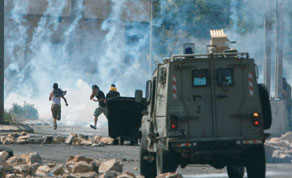
| Palestinian protesters run for cover from the teargas fired by Israeli soldiers during clashes outside the Ofer Prison near Ramallah yesterday following a demonstration in support of Palestinian prisoners on hunger strike in Israeli jails |
Hundreds of Palestinians on hunger strike in Israeli jails said yesterday they would shun vitamin supplements and prison clinics in an escalation of their mass protest against detention conditions.
“We swear we will not retreat. We are potential martyrs. Either we live in dignity or die,” prisoner organisers said in a letter announcing the move and which was read out by Ismail Haniya, head of the Islamist Hamas government in the Gaza Strip, during a demonstration.
An estimated 1,600 inmates out of 4,800 launched the hunger strike on April 17 to demand improved conditions in Israeli custody, such as an end to solitary confinement and more family visits. They have also challenged Israel’s policy of indefinite detention without charge of suspected Palestinian militants.
The fate of the hunger strikers has touched a raw nerve among Palestinians, with daily support rallies in the occupied West Bank and Gaza, and political leaders warning that Israel could face new violence should any prisoner die.
Dozens of Palestinians, including militants and politicians who had served terms in Israeli jails in the past, have gone on hunger strikes in tents put up in solidarity in the West Bank and Gaza Strip, which witnessed daily heavy attendance by residents and visitors from Arab and foreign countries.
The prisoners include Islamists from Hamas and Islamic Jihad, which reject peace with the Jewish state, as well as members of Palestinian President Mahmoud Abbas’s secular and Western-backed Fatah movement.
Israel says all prisoners receive adequate medical attention, including in civilian hospitals if required.
A Prisons Service spokeswoman said there was no immediate sign of the hunger strike being stepped up.
“As of now, I know that those who should be receiving extra care are receiving it,” the spokeswoman, Sivan Weizman, said.
Defending its so-called “administrative detention” policy, Israel says some cases cannot immediately be brought to open court for fear of exposing Palestinian intelligence sources that have co-operated with Israeli security organs against militants.
Two inmates who helped launch the hunger strike, Bilal Diab and Thaer Halahla of Islamic Jihad, were in the 74th day of their fast yesterday.
Anat Litvin of Physicians for Human Rights in Israel quoted Halahleh’s doctor as saying his death could be imminent.
“What is very worrisome is the fact that he said that he doesn’t want to be saved if something happens to him and he loses consciousness,” Litvin said, adding that the Prisons Service’s medical facilities might prove inadequate.
“They don’t have the equipment, they don’t have the expertise; constant follow-up that is very much needed is not available,” she said.
The World Health Organisation yesterday urged Israel to give quick and suitable healthcare to the hunger-strikers, including their transfer to civilian hospitals.
The WHO said it was “extremely concerned” about their health, noting one was suffering from the blood condition thalassaemia and has “refused his regular life-saving blood transfusions in addition to food”.
“WHO calls on the Israeli authorities to ensure immediate and adequate access to appropriate ongoing health care for the hunger-strikers,” it said in a statement from its Jerusalem office.
“WHO also requests Israel to ensure that... release to hospital be facilitated for prisoners requiring medical treatment.”
Yesterday a 20-year-old Palestinian was seriously wounded in the eye by Israeli fire during a solidarity protest in the West Bank village of Abud, near Ramallah, Palestinian medical sources said.
Thousands of Palestinians took part in rallies across the occupied West Bank, in the Gaza Strip and in Israeli-annexed East Jerusalem.
On Thursday Abbas raised the fate of the prisoners in discussions with the UN’s Middle East peace envoy Robert Serry, a statement from the UN official’s office said.
“President Abbas and Mr Serry both agreed on the urgency of resolving this issue immediately,” the statement said.
And during a visit to a solidarity tent for the hunger strikers, in El Bireh, near Ramallah, Abbas said he had “no greater concern” than the prisoners.