


For most people, being born with a voracious appetite might speak of nothing more than their good health or an efficient metabolism. And then for some rare ones like Australian celebrity chef Greg Malouf, it can be the cornerstone of a successful culinary career.
“Back in Australia, we had three generations of our Lebanese family; my grandmother and my great-grandmother lived under one roof with us. I was lucky enough to be under their wings,” recalls the Michelin-starred chef, after wrapping up a whirlwind session in the kitchen, “They were constantly cooking food and I had a massive appetite as a kid. I guess it all started from there – having a huge appetite.”
The Melbourne-born Malouf is the second of three sons born to Lebanese parents. In Malouf’s kitchen, traditional Middle Eastern dishes get an ingenious modern makeover; a transformation so smooth and yet so distinctive that his style of cooking is known around Australia as “Modern Middle Eastern”.
Down in Doha around the weekend to present his signature Middle Eastern Ramadan dinner preview to guests at The Spice Market in the W Doha Hotel & Residences, Malouf settles for a chat with Community at a restaurant downstairs and chuckles and nods disapprovingly when confronted with words such as fusion or twist.
“Interpretation is what it is,” Malouf explains, “What I cook is Middle Eastern food seen through my eyes and a massive amount of it is based on my childhood memories.” While documented recipes aren’t a norm in Lebanese food, Malouf’s memories of his mother and aunt cooking Lebanese dishes have always stayed on as mental sticky notes. In fact, his mother May’s cooking is at the core of what inspired him to be a chef – even if she discouraged him from pursuing that path. “In Lebanese kitchens, there is always an army of women. They would always push me out,” he says.
As a kid, the most definitive realisation for Malouf was that he wanted to cook. “Secondly, I knew I wanted to cook Arabic food because I loved it so much,” he says, “So I thought I need to train in Western food because of the techniques that I had to master. Be it holding the knife properly or making the sauces just right or understanding products and their dynamics, I wanted to understand the romance of food, which I knew about, but it was also about the chemistry and physics of food, the laborious part of it that I wanted to grasp.”
At 15, Malouf went to Sydney where he spent three months working in a Mexican kitchen – his first culinary stint. At the culinary school, the William Angliss Institute in Melbourne, Malouf gave his all, learning the basics and more of international cuisine in Australia, Italy, France, Belgium, Hong Kong and England. “However, I knew I wanted to focus on Middle Eastern cuisine,” he says.
Being the head chef at the award-winning Melbourne restaurant MoMo for 11 years, and helming the well-known Petersham Nurseries Café in Richmond, UK, in 2012, are some of the highlights of his many achievements. Malouf’s Middle Eastern menu at Petersham ensured that the restaurant retained its Michelin star that was awarded a year earlier. Currently, Malouf runs Clé Dubai, his first restaurant in the region.
Looking back, Malouf says, “As a kid, when you cook, you tend to put as many things on the plate as you can. After you start maturing as a chef, you learn about restraint. There’s nothing more beautiful than you stepping into the kitchen to cook and the word restraint is already there, and you don’t even have to think about it.”
Earlier on, even Malouf’s family picked on his cooking. “They used to criticise me a lot, for experimenting too much and greatly changing what is original,” he says, “Then I understood that there needs to be integrity with the dish and you must respect the dish. To make a simple thing like tabbouleh, you need to have the right products – parsley that actually tastes like parsley, tomatoes that are in season. Using good ingredients is something that makes a simple dish turn into something wonderful.”
In fact, a big part of Malouf’s ‘Modern Middle Eastern’ magic relies on the quality of produce – the fresher, obviously, the better. “If you look at the way the Italians cook, it’s the same process. They take a beautiful ingredient and don’t do a lot to it. If you notice, Lebanese food uses ingredients that are very refreshing – lots of lemon, coriander, parsley, mint, and yogurt. These are all lively flavours. If the yogurt you use is pretty ordinary, there’s a problem,” he explains.
Over the years, Malouf’s European training and inspiration-seeking travels have informed his version of Middle Eastern food prepared with Western technique, which seems to have won over everybody from Kate Winslet to Bill Gates. Malouf draws culinary insights from all over – he has written half a dozen cookbooks – and believes that the West trusts his palate.
“Be it North African, Persian, or Turkish, I understand a little about a lot in each region. If I look back to the time when I was cooking in Australia or the UK, I think I had a lot more accessibility, firstly, to fresh produce; and secondly, the Western customer base sort of understood where I was coming from and were very willing to try new and different things. Middle Eastern food is still quite exotic in the Western world,” he says.
For Malouf, it seems no permutation-combination is too risqué. “It’s easy to incorporate Arabic flavours into risotto, for instance. It’s nice to make risotto and add some toasted vermicelli noodles to it towards the end,” he says, “That’s where I disassociate myself from my mother’s kitchen and move into other food cultures and making the main dish have a slight Middle Eastern touch.”
Case in point was the feast he laid out at The Spice Market at the W Doha. “The lamb was slow-braised, the chicken was wrapped in sage and slightly spiced up, and the tabbouleh was done with lentils,” Malouf says about the menu he had just finished whipping up, “So it’s just treating your dishes in a loving way and actually making them look a little more interesting.”
Although what drives Malouf are the products and the honesty of the dish, he needs to have his own expression or “some sort of contemporary connection to it.” He says, “I’m not a traditionalist as such. If I knew my mother was cooking something that I dearly love, I would drop everything to go and eat it.”
What also drives Malouf’s culinary adventures is his express intention to put Lebanese food on a pedestal. “It’s a shame that there are only a handful of good chefs handling such a great cuisine,” the 50-something Malouf says, “That’s the toughest bit, especially in this part of the world. I get a lot more interest from the Lebanese in Dubai but I get my fair share of criticism as well. Many wonder why they must spend this amount of money when they can go down the road and get themselves a falafel. But their falafel will be cooked in dirty oil and the coriander will be from here and the chick peas will be from there. It’s different.”
Citing the instance of hummus, Malouf says it’s “such a difficult dish to make.” He explains, “You might think making hummus is simple but it’s not, and it’s being destroyed at supermarkets. I see a lot of Lebanese restaurants taking a lot of shortcuts, becoming lazy, service-wise, décor-wise, kitchen-wise, which is sad. That’s why I like to push the boundaries.”
Malouf has often felt compelled to have this discussion. Like with the Lebanese and Syrian gentlemen who work with him and who were “a little stubborn” at the start. “But then they started to understand where I was coming from,” Malouf says, “It’s all about what they were taught in the kitchen. I told them: look at your mother and what she was making! That’s a better representation of who trained you in these kitchens. I don’t think your mother was using citric acid; she must have been using lemon juice and seasonal ingredients.”
As for his mother, Malouf finally won her over with his cooking, too. “That was one of the greatest moments of my career,” Malouf says, “It took a while but about five years ago, my mother started craving the Salmon Kibbeh I make. From that moment onwards, I knew I had arrived.”
Earlier on, she would just rubbish her son’s creations and now she was a fan of at least three dishes. Malouf says, “She just wanted me to make the Salmon Kibbeh… constantly!”
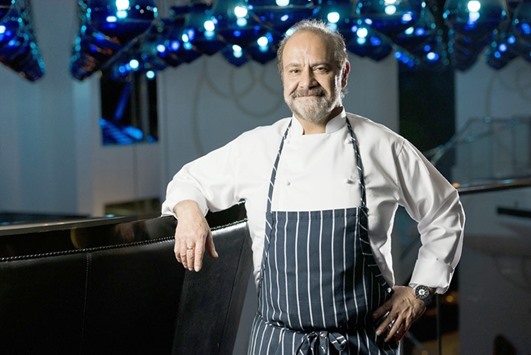
MASTER CHEF: Greg Malouf at the W Doha during the weekend.