


President Barack Obama held talks with Custodian of the Two Holy Mosques King Salman of Saudi Arabia yesterday as he began a two-day visit hoping to ease tensions with the historic US ally.
Riyadh and its Arab Gulf neighbours have bristled at what they see as Washington’s tilt towards Iran after Tehran’s landmark nuclear deal with world powers.
Obama, making probably his last visit to Riyadh as president, attends a summit of Gulf leaders today hoping to focus on intensifying the fight against the Islamic State group and resolving the wars in Syria and Yemen.
King Salman, 80, greeted the arriving Gulf leaders at a central Riyadh airbase but was not present when Obama landed at King Khalid International Airport in the city’s north.
Then, Salman along with his crown prince and deputy crown prince greeted Obama as a military band played.
After waving and walking down a red carpet on the stairs from Air Force One, he was greeted this time by Prince Faisal bin Abdulaziz, the governor of Riyadh, and Foreign Minister Adel al-Jubeir.
Saudi state news channel Al-Ekhbaria did not broadcast Obama’s arrival although it did have live coverage of the Gulf leaders’ landing.
“I and the Saudi people are very pleased that you Mr President are visiting us,” Salman said at his Erga Palace before a two-hour meeting with Obama, who responded that the US was “very grateful for your hospitality.”
The kingdom’s official Saudi Press Agency gave no detail of the talks but said they included “combating terrorism”.
Obama was to meet later with Abu Dhabi’s Crown Prince Sheikh Mohamed bin Zayed al-Nahyan to see how to “reinforce co-operation to defeat the Islamic State group”, the White House said.
Tensions between Riyadh and Washington have increased sharply due to what Saudi Arabia sees as Obama’s disengagement from traditional US allies in the region and opening towards Iran.
Though the visit is being touted as an “alliance-building” effort, “it will just as likely highlight how far Washington and Riyadh have drifted apart in the past eight years,” Simon Henderson, of the Washington Institute for Near East Policy, wrote in Foreign Policy magazine.
Iran’s emergence from international isolation after the nuclear deal has raised deep concerns among Gulf Arab states, who oppose Tehran indirectly in a range of Middle East conflicts.
The weeks before the visit were marked by Saudi outrage over Obama’s comments published in the April edition of US magazine The Atlantic.
He said the Saudis needed to “share” the Middle East with their Iranian rivals, because competition between Riyadh and Tehran has helped to feed proxy wars and chaos in Syria, Iraq and Yemen.
Obama, making his fourth trip to the kingdom, has stated his opposition to the draft legislation.
Ahead of the visit the White House emphasised the strength of an alliance that has endured more than 70 years.
Obama will be joined at today’s summit of the six-nation Gulf Co-operation Council by Defence Secretary Ashton Carter and Secretary of State John Kerry.
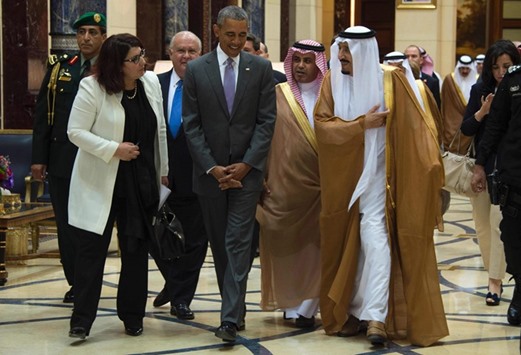
US President Barack Obama speaks with Custodian of the Two Holy Mosques King Salman of Saudi Arabia at Erga Palace in Riyadh yesterday.