


Stock exchange operator Euronext NV is evaluating how to create roadblocks to a merger between its London and Frankfurt-based competitors because of concern the deal would marginalise its own role in European trading, according to people familiar with the matter.
Euronext is working with advisers, including consultants and lawyers, as it prepares to argue to regulators in Brussels that letting London Stock Exchange Group and Deutsche Boerse fuse together would hurt competition in the region, said the people, who asked not to be identified because the discussions are private.
The Anglo-German combination would tower over other European exchange companies and would be among the biggest in the world. Euronext is also considering lobbying in favour of a counterbid for LSE by US rival Intercontinental Exchange, according to one of the people. Atlanta-based ICE has said it’s weighing an offer for LSE.
The US exchange is spinning off parts of LSE, including Italian exchange Borsa Italiana and the French clearing unit, and Euronext might try to buy those assets, people familiar with the matter have said.
Euronext has hired BNP Paribas SA and Rothschild & Co to advise on potentially buying assets, according to people familiar with the discussions. A Euronext spokeswoman declined to comment, as did representatives for BNP and Rothschild.
Amid these deliberations, Euronext on Monday named a new chief financial officer: Giorgio Modica, a BNP Paribas banker who has worked with exchanges on mergers and acquisitions. The appointment is a sign to some that Euronext will seek deals.
Euronext’s statement announcing the replacement of Amaury Dauge noted that Modica’s job at the bank included responsibility for stock exchanges in the Italian and Spanish markets - notable because Euronext could bulk up in those countries. Euronext runs markets in cities including Paris and Amsterdam. LSE and Deutsche Boerse’s chief executives were scheduled to meet with European Union Financial Services Commissioner Jonathan Hill on Monday.
LSE CEO Xavier Rolet has speculated about Euronext’s intentions, telling the City AM newspaper earlier this month that the company is vying for ICE to win the LSE so it can snap up any spun-off pieces. Rolet acknowledged his duty to consider other offers, but said in an interview that the remarks were intended as a response to reports that ICE would dismantle the company.
LSE and Deutsche Boerse are already Europe’s biggest exchange operators, with their market values at about $14bn and $16bn, respectively. That dwarfs Euronext and Madrid’s exchange, which have market capitalisations of about $2.9bn each.
Like most heads of stock exchanges, Euronext CEO Stephane Boujnah is faced with diversifying his company as competition erodes profits from equity trading. To do so, Euronext has sought to widen its offerings on derivatives, exchange-traded funds and indexes. Boujnah is a former Banco Santander SA banker and adviser to Dominique Strauss-Kahn. He took over at Euronext in November.
The company was previously part of a bigger empire that included Liffe, a London-based derivatives exchange, and the New York Stock Exchange, both of which are now owned by ICE. Euronext was severed from those companies when it was spun off in a June 2014 IPO.
Euronext may struggle to compete with a combined LSE and Deutsche Boerse, which would have a massive footprint in everything from exchange listings to exchange-traded funds and clearing. That’s why Euronext is hoping European regulators will come to its rescue by blocking the transaction, the people said. There’s precedent for that possibility.
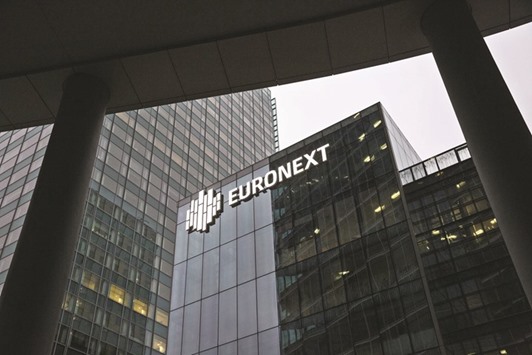
The Euronext logo is seen on the company’s offices in La Defense business district in Paris. Euronext is evaluating how to create roadblocks to a merger between its London and Frankfurt-based competitors because of concern the deal would marginalise its own role in European trading, according to people familiar with the matter.