


 |
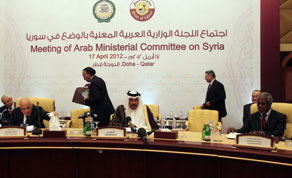
| HE the Prime Minister and Foreign Minister Sheikh Hamad bin Jassim bin Jabor al-Thani, Arab League Secretary General Nabil al-Arabi (left), and UN-Arab League envoy to Syria Kofi Annan attend the meeting of the Arab Ministerial Committee on Syria in Doha yesterday |
Qatari Prime Minister and Foreign Minister HE Sheikh Hamad bin Jassim bin Jabor al-Thani said yesterday that Syria is not complying with UN-Arab League envoy Kofi Annan’s peace plan and that it has failed to show any change to its approach.
“The Syrian regime has not complied with any” of the six points in Annan’s plan, Sheikh Hamad bin Jassim told reporters following an Arab ministerial meeting in Doha.
“Until now we haven’t seen any crucial changes in the way the Syrian regime is dealing with” the plan, he said. “We hope the killing would stop in Syria in order for the implementation to seriously begin.”
When asked about arming rebels, Sheikh Hamad bin Jassim said: “No, we haven’t armed the opposition.”
But “if the situation remains unresolved, the Syrian people must be helped to defend themselves”, he said.
Meanwhile, Arab League Secretary General Nabil al-Arabi, who also attended the Doha meeting along with Annan, said: “There must be an immediate and complete ceasefire in order for the political process to begin.”
“Annan’s mission is a political one which would take some time,” Arabi had said at the opening of the meeting.
In a statement, the Arab ministerial committee urged “all parties to comply to the end of armed operations and human rights violations, and to ensure humanitarian aid reaches those who need it without any obstacles”.
It also called onto the UN “Security Council to quickly deploy observers in Syria”.
The Damascus government, it added, must “facilitate the observers’ work and allow them to unconditionally visit all areas across Syria at the time the team chooses.”
The committee also assigned Arabi with the task of “inviting all opposition parties to meet at the Arab League headquarters in Cairo before the end of this month... to prepare for launching a national dialogue between the government and the opposition”.
The Arab ministerial committee, chaired by Qatar, includes Saudi Arabia, Oman, Egypt, Sudan, Algeria, Iraq, and Kuwait.
UN observers yesterday admitted they face a tough task to firm up a ceasefire in Syria, as seven civilians were killed in the latest violence on the sixth day of a tenuous truce.
Colonel Ahmed Himmiche, a Moroccan who heads an advance team of six members preparing for the deployment of a 30-person mission, said the observers would move forward one step at a time.
Secretary of State Hillary Clinton said the US was still “hoping for the best” but was discussing with other powers what to do in the event the peace plan collapses.
Her Russian counterpart, Sergei Lavrov, pointed the finger at the opposition - 11 of 35 people killed in violence on Monday were soldiers - and called on its foreign supporters to press the rebels to honour the hard-won truce.
Four of the seven dead yesterday were killed in regime shelling of Idlib, a northwestern province close to the Turkish border, where there is a strong presence of rebel fighters, the Syrian Observatory for Human Rights said.
Shelling killed three more and wounded dozens at Basr Al Harir in southern Daraa province, cradle of the 13-month-old uprising against President Bashar al-Assad’s regime, the Britain-based watchdog said.
The rebel districts of Khaldiyeh and Bayyada in the flashpoint central city of Homs also came under renewed shelling, it added.
The opposition Syrian National Council accused the regime of “flagrant violations of the ceasefire” and called on the UN observers to “travel to Idlib and Homs immediately to see first-hand the massacres which the regime is carrying out and has not stopped carrying out”.
Colonel Himmiche said “it’s a difficult mission that needs co-ordination and planning.”
“No ceasefire, not even the beginnings of a political process—this mission will be one of the toughest ever undertaken by the UN,” he added.
Clinton called on Damascus to honour Annan’s plan in full, not just the promised ceasefire.
“What the Assad regime needs to do is to make clear that they’re going to silence their guns, withdraw their troops and work toward fulfilling the six-point plan,” she said.
Complying with the plan also means allowing peaceful demonstrations, releasing political prisoners and allowing a peaceful political transition to begin, Clinton added.
“We want to see a political process begin, but if violence is renewed, the regime reverts to shelling its own people and causing a great deal of death and injury, then we’re going to have to get back to planning what our next steps (are).”
French Foreign Minister Alain Juppe said “stronger sanctions” against Damascus must be adopted to “pressure the Syrian regime” and erode its resources.
Juppe has also invited several of his fellow foreign ministers to talks in Paris tomorrow on ways to boost the pressure on Syria, a government source said.
He had met officials from 50 of the countries that have imposed sanctions on Assad’s regime.
“We know that the Syrian authorities, whose financial reserves have, according to our information, been cut in half, are actively seeking alternative ways to get round these sanctions,” he warned.
In a clear reference to Moscow, the 50 countries yesterday expressed “strong disapproval of any financial or other support, in particular the continuation of arms sales to the Syrian regime”.
Russia, which voted in favour of the text after vetoing two previous draft resolutions, will be “substantially” represented in the UN mission, Deputy Foreign Minister Sergei Ryabkov said.
“The specifics of our participation in the observers mission are being worked on right now,” Interfax quoted Ryabkov as saying.