


 |
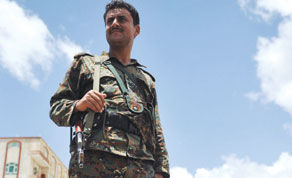
| A soldier keeps watch at a checkpoint in line with a new security deployment in Sanaa yesterday |
At least 133 people were killed in 48 hours of clashes pitting Yemeni soldiers backed by tribesmen against Al Qaeda militants, officials said yesterday, as the extremists vowed to retake a strategic town. At least 124 people were killed in battles in the southern town of Loder in Abyan province, sparked when militants linked to Al Qaeda raided an army barracks there on Monday.
“One hundred and twenty-four people were killed in two days” of clashes around Loder which is besieged by Al Qaeda, said a military official.
The toll, which was confirmed by tribal sources, comprised 102 Al Qaeda militants - among them 12 Somalis and many Saudis - 14 soldiers, and eight tribesmen fighting alongside the army.
Twenty-eight of the militants and two armed civilians were killed yesterday, while the rest died on Monday.
A government official in Loder said yesterday that Al Qaeda militants have surrounded the area in preparation for the complete takeover of the town.
“Al Qaeda has distributed statements throughout the town saying that it is determined to take control of Loder,” said the official who requested anonymity.
Loder is located some 150km northeast of Zinjibar, the Abyan provincial capital which the Al Qaeda-linked self-proclaimed Ansar Al Shariah (Partisans of Shariah) militants overran in May last year.
Al Qaeda briefly seized Loder in August 2010 before being driven out by the army.
A tribal source had said that the militants wanted to retake it because of its strategic location between Shabwa, Bayda and Lahij provinces where Al Qaeda in the Arabian Peninsula (AQAP) is also active.
Ansar Al Shariah said on Monday it had captured four tanks and anti-aircraft guns and a large cache of arms and ammunition in fighting with government troops in Loder.
Residents said fighting intensified yesterday with warplanes bombing two sites held by the Islamist fighters 10km west of Loder, destroying at least one of the tanks the group had seized.
Vehicles laden with fighters and arms left the southern city of Jaar, which militants took a year ago, for Loder, witnesses said, while a local official in Loder said more tribesmen from neighbouring towns had joined the fight against the Islamists.
Monday’s attack followed a series of air strikes that killed 24 suspected Al Qaeda militants in their southern and eastern strongholds.
In a fresh Al Qaeda assault yesterday, the militants killed nine soldiers in an attack on a makeshift military post on a desert road in the country’s mostly lawless eastern provinces, a security official said.
“Al Qaeda militants attacked a military position on the road between Hadramout and Marib province”, the official said requesting anonymity, adding that “nine soldiers were killed” in the assault.
He said at least eight other soldiers were wounded.
Al Qaeda gunmen attacked the soldiers just after dawn with “automatic weapons”, the official added.
The US considers the Yemen-based AQAP to be the most deadly and active branch of the global terror network.
Ansar Al Shariah have exploited a decline in central government control that accompanied Arab Spring-inspired protests that eventually forced president Ali Abdullah Saleh to cede power.
Attacks targeting security forces have intensified since Saleh’s successor, Abd-Rabbu Mansour Hadi, took office in February and vowed to continue the fight against the extremists.
Last month, the Islamist insurgents—who have launched near daily attacks against Yemeni forces for the past two months—attacked troops in Zinjibar killing 185 soldiers.
Saudi Arabia and the US backed the transfer of power to Hadi in the hope that it would help prevent the country sliding into chaos, which might have enabled Al Qaeda to establish a foothold near key oil shipping routes.
Conflict with Islamists in the south is only one of several challenges facing Hadi, who took office vowing to fight Al Qaeda only to have more than 100 soldiers killed in attacks by militants in his first few days in power.
Yemen’s main airport in Sanaa was paralysed for a day on Saturday when officers and tribesmen loyal to Saleh forced it to close in protest at the sacking of the air force commander, a half-brother of Saleh. A government official said they backed down only after pressure from the US and Gulf countries, which had crafted the deal that made Hadi president.