


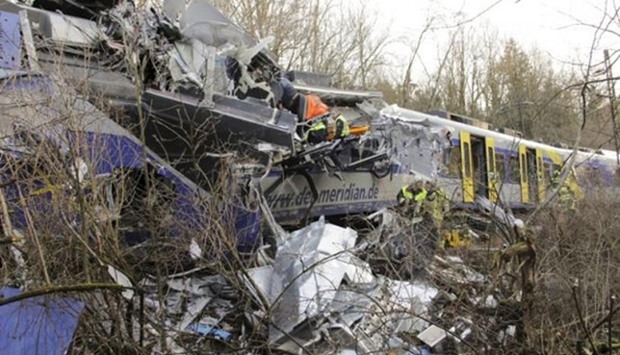
Two commuter trains crashed head-on at high speed near the southern spa town of Bad Aibling on February 9 in one of Germany's deadliest accidents in years, that also left dozens injured.
Prosecutors, who had previously blamed the signalling worker's ‘human error’, said Tuesday they had now remanded the 39-year-old in custody on involuntary manslaughter and other charges.
Citing the investigation, prosecutors said ‘the accused, in breach of railway service regulations, turned on his mobile phone while on duty on the morning of the disaster, launched an online computer game and actively played it for a long period until shortly before the train collision.’
‘It must be assumed... that the accused was distracted by this,’ the chief prosecutor in the southern town of Traunstein said in a statement.
‘Apparently because of this distraction, the accused made... false assumptions, sent the wrong signals to the trains and pressed the wrong radio key combinations in both emergency calls so that the drivers could not receive them.’
This meant his error was not just a ‘momentary lapse’ but represented a ‘serious breach of duty’, they judged.
The accused had admitted to playing the game but denied being distracted by it, said the statement.
The worker, who has several years of experience in the job, had allowed two trains from opposite directions, carrying about 150 passengers in total, to travel on a single track. They collided in a forest area about 60 kilometres (37 miles) southeast of Munich, the Bavarian capital.
The accident was Germany's first fatal train crash since April 2012, when three people were killed and 13 injured in a collision between two regional trains in the western city of Offenbach.
The country's deadliest post-war accident happened in 1998, when a high-speed ICE train linking Munich and Hamburg derailed in the northern town of Eschede, killing 101 people and injuring 88.