


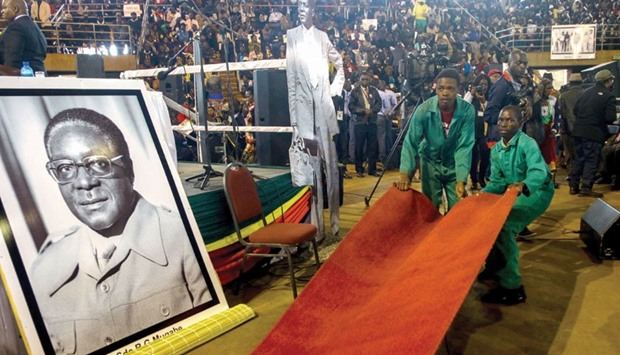
Workers preparing the red carpet ahead of a meeting last night between Mugabe and the Zimbabwe National Liberation War Veterans Association in Harare.
Zimbabwean President Robert Mugabe has accused potential successors for wishing him dead and told ruling ZANU-PF supporters to unite against foreign enemies that he said wanted to destroy the Southern African nation.
Africa’s oldest leader at 92 years, Mugabe has held power since independence from Britain in 1980 and says his heir must be chosen democratically and that his wife will not automatically inherit the role.
Mugabe told a meeting of about 10,000 veterans of Zimbabwe’s 1970s independence war that his frequent trips to Malaysia and Singapore had fed newspaper reports that he was ill and sometimes dying, stoking succession fights in ZANU-PF.
“You then see a stampede now, they will be saying the president is dying. ‘I am not dying, shame on you’,” Mugabe said during the first ever such meeting with the veterans.
“I am there at the mercy of the people. If the people say no, go, I go. But if the people say no, we still want you, I stay on,” said Mugabe.
Yesterday’s meeting came at a time of high tensions in ZANU-PF as party officials position themselves for a post-Mugabe era.
Local media had reported the meeting could split ZANU-PF, especially after Mugabe said last month the veterans had indicated they wanted him to retire.
Instead, veterans pledged their loyalty to Mugabe, but also presented a list of grievances and demands for top positions in government and state-owned firms, diplomatic posts and at least a fifth of all farmland and mining concessions.
The veterans, 30,000 in total, also want their monthly allowances increased from $260.
But Mugabe said the government would only meet such demands if it had the resources.
The last time Mugabe caved into demands from veterans was on November 14, 1997 when the Zimbabwean dollar crashed by 72% after the government announced unbudgeted allowances for veterans.
That day became known as “Black Friday”.
But without balance of payment support or foreign credit, Zimbabwe cannot afford such demands.
It already runs its budget hand-to-mouth, leaving it with no money for infrastructure.
Mugabe has agreed to major reforms, such as compensation for evicted white farmers and a big reduction in public sector wages in a bid to woo back international lenders and to have part of its $8bn in foreign debt cancelled.
Mugabe said Zimbabwe’s bad record with debtors was holding back potential funding from China, Japan and India.
“We have a disease in Zimbabwe where we just want to receive and forget that debts are supposed to be repaid. It’s a very bad culture,” said Mugabe in a monologue that lasted 90 minutes.
The war veterans have often played a crucial, and violent, role in supporting Mugabe.
But, as the president has become more frail, they have been infuriated by criticism aimed at them by his wife, Grace.
“I am sorry you have not had this opportunity before,” Mugabe said addressing his first open meeting with war veterans since fighting ended with Zimbabwe’s independence in 1980.
“The condition of the war veterans is a priority and I leave you with my promise,” he said, vowing to allocate money to pay for hospital bills and children’s school fees.
In February, Zimbabwean police shocked many observers by using water cannons and teargas to prevent a meeting planned by the war veterans to air their grievances.
Some of the veterans back former vice-president Joyce Mujuru, herself a former fighter, to take over from Mugabe.
She was expelled from the ruling ZANU-PF party in 2015 at the apparent instigation of Grace Mugabe, who accused her of plotting to topple the president.
“We played a role in the liberation of our country,” Menias Chimbaira, 62, told AFP. “We need to remind the younger generations, especially the young politicians, to accord us our right place.”