


Israel last year recorded stable economic growth of 2.5% and its lowest unemployment rate in three decades, the central bank announced yesterday.
Israel’s economic growth was hampered in part by a decline in exports due to the faltering global economy and its strengthening currency, the shekel, the Bank of Israel said.
At the same time, the drop in unemployment to 5.3% was attributed to an increase in “employment-intensive commerce and business services” and a boost in public service jobs in the country of 8mn people.
The unemployment rate was 5.9% in 2014 and has declined for the past five years, resulting in 2015 in the lowest figure since the mid-1980.
However, as in other countries, the number includes only those actively seeking work.
That means it does not count those in Israel’s substantial ultra-Orthodox Jewish community who choose to pursue religious studies over employment.
The Bank of Israel projects 2.8% economic growth for 2016. It recorded 2.6% growth in 2014.
The cost of living has been a major issue in Israel, and the Organisation for Economic Cooperation and Development (OECD) said in January that while the country’s economy was sound, it continues to have “a high level of inequality.”
Prime Minister Benjamin Netanyahu welcomed yesterday’s data, saying “the economy is at full employment.”
“The key to the future depends on growth,” he said.
“It must be understood that everything that we want to achieve vis-a-vis budgets, services and improving infrastructures, everything that is important for a citizen, requires growth.”
Netanyahu has been seeking to push through an agreement designed to lead to the exploitation of major natural gas reserves in the Mediterranean.
The supreme court, however, recently struck down the deal reached with a consortium that includes US-based Noble Energy and gave the government a year to amend it.
Justices objected to a clause in the agreement that would prevent Israel from altering gas industry regulations for a decade.
Critics say the agreement overly favours the companies involved.
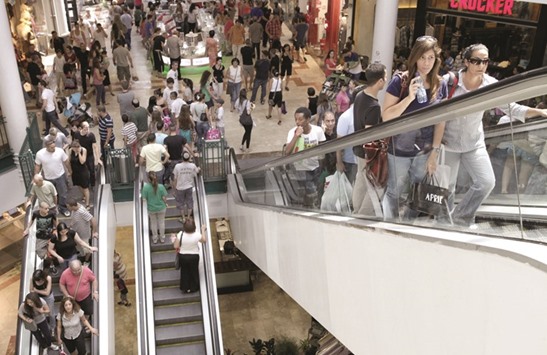
Customers stand on escalators inside a shopping mall in Jerusalem (file). The Bank of Israel projects a 2.8% economic growth for 2016.